
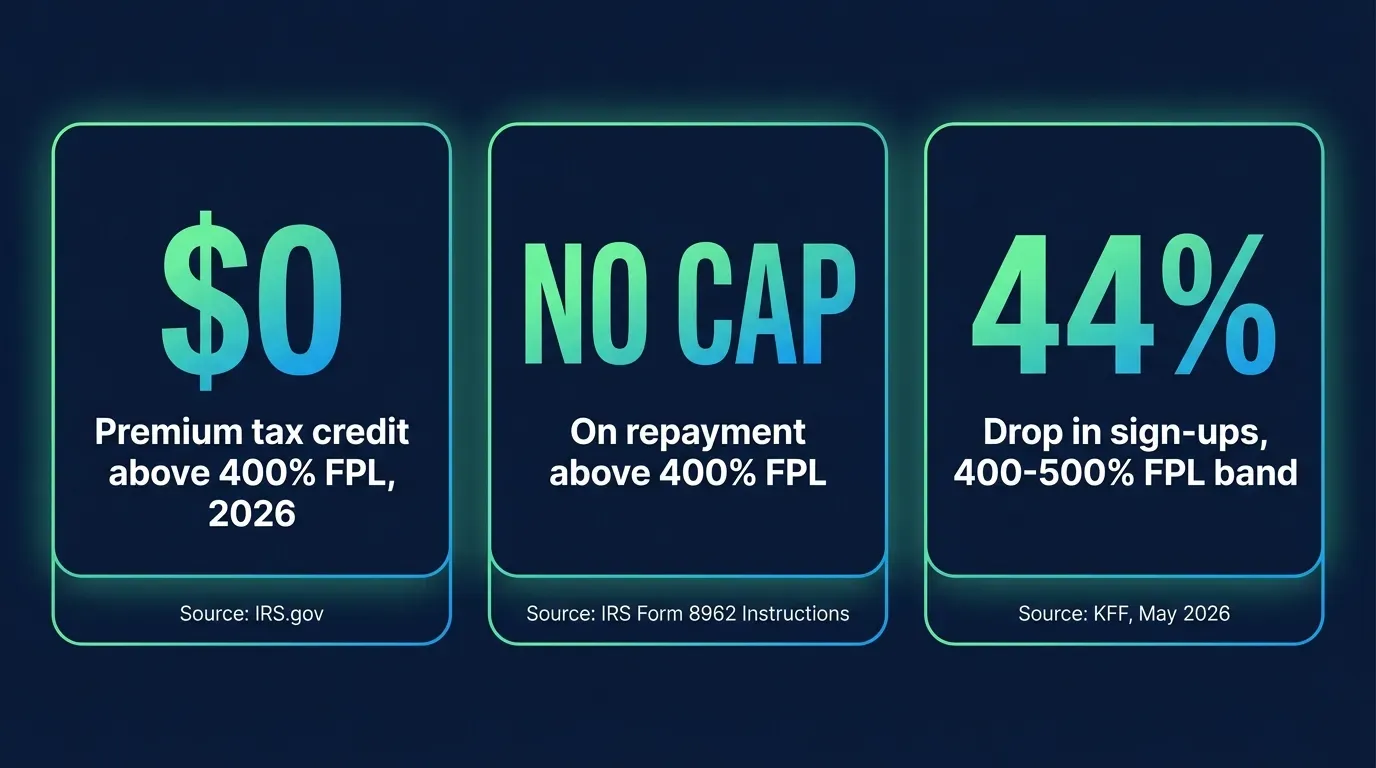
The ACA subsidy cliff is back for 2026: a household with income above 400% of the federal poverty level for its size gets zero premium tax credit for the year, and unlike the years since 2021, there’s no cap on how much of an advance subsidy that household has to repay if their income lands above that line at tax time. That’s not a future-tense warning. It’s the current rule, confirmed directly on the IRS’s own eligibility page, and it applies to every ACA client on your book right now, in July, whether or not anyone has looked at their income since Open Enrollment closed in January.
Most agents built their income estimates for the current plan year back in November or December, during a six-week enrollment sprint, and then moved on to the next thing. Nobody circled back in the spring. Nobody’s going to circle back in the fall unless it’s built into the calendar. And a client whose freelance income ticked up, who picked up a second job, or whose spouse went back to work sits there quietly drifting toward a line that, this year, has real teeth on both sides of it.
Key takeaways
- The enhanced premium tax credits (American Rescue Plan, extended by the Inflation Reduction Act) expired December 31, 2025. For 2026, income above 400% of FPL gets no premium tax credit at all (IRS, Eligibility for the Premium Tax Credit).
- The IRS's Form 8962 repayment limitation table caps excess-subsidy repayment below 400% FPL, but shows no limitation at 400% FPL or above — full repayment applies (IRS, 2025 Instructions for Form 8962, Table 5).
- 2026 plan-year eligibility is calculated against the 2025 HHS poverty guidelines: 400% of FPL works out to $62,600 for one person and $128,600 for a household of four in the 48 contiguous states and D.C.
- KFF projects effectuated marketplace enrollment falling from 22.3 million (2025) to roughly 17.5 million in 2026, with the 400-500% FPL income band, just 3% of 2025 sign-ups, accounting for 27% of the total drop.
- Ambrose's plan-quoter spoke re-runs a household's ACA subsidy position from age, ZIP, household size, and income tier in one query, with income scrubbed before the quoting engine ever sees it (Ambrose docs, spoke-plan-quoter).
What the ACA subsidy cliff actually means in 2026
A premium tax credit (PTC) is the subsidy that lowers what an ACA marketplace enrollee pays for a benchmark Silver plan, calculated against their household’s modified adjusted gross income (MAGI) as a percentage of the federal poverty level. From 2021 through 2025, the American Rescue Plan Act removed the upper income limit entirely and capped what anyone paid at 8.5% of income, extended through the Inflation Reduction Act. That’s the version of the ACA marketplace most currently-licensed agents have only ever sold.
That enhancement expired at the end of 2025. The IRS’s own guidance is direct about what replaces it: American Rescue Plan changes applied “for 2021 and 2022,” and for “years other than 2021 and 2022” the standard rule governs, which requires household income of “no more than 400 percent of the federal poverty line for your family size” to qualify for any premium tax credit (IRS, Eligibility for the Premium Tax Credit). 2026 is a “year other than 2021 and 2022.” The cliff is back, in full, and it is not a gradual phase-out. A household at 399% of FPL gets a subsidized plan. The same household at 401% gets the full, unsubsidized sticker price, for the entire plan year, until they report an income change or re-enroll.
The part that changes the compliance math for agents specifically is the repayment side. Under the ARPA/IRA years, going over 400% FPL wasn’t really a cliff, because the subsidy didn’t stop, it just shrank. For 2026, the two mechanics stack: a household that crosses the line loses the subsidy going forward, and if advance payments were made based on an income estimate that turns out to be wrong, the excess has to be paid back at tax time, with the repayment cap that protects lower-income households simply not applying once you’re at or above 400% FPL. Both of those facts come directly from primary IRS sources, not from a summary of them, which is worth knowing because a lot of the trade coverage on this topic is thinner than it looks.
| Mechanic | 2021-2025 (ARPA / IRA enhanced credits) | 2026 (standard rule restored) |
|---|---|---|
| Premium tax credit above 400% FPL | Still available, capped at 8.5% of income toward the benchmark plan | $0 — no premium tax credit at any income above the line |
| Repayment cap on excess APTC above 400% FPL | Not a relevant question — the income ceiling didn't exist | No cap; full excess advance premium tax credit is repayable |
| Effect of income drifting past the line mid-year | Subsidy shrank gradually; no hard cutoff | Subsidy stops entirely; prior advance payments become repayable in full |
This is precisely why a book of ACA clients that renewed smoothly under the 2021-2025 rules can’t be assumed safe under the 2026 rules without a fresh look. A household that drifted from 380% to 410% of FPL in, say, 2023 would barely have noticed; the same drift in 2026 is the difference between a subsidized plan and a full-price one with a repayment bill attached.
The 2026 FPL cliff, by household size
Marketplace eligibility for a given plan year is calculated against the poverty guidelines HHS published the January before that plan year — the 2025 guidelines govern 2026 coverage, not the 2026 guidelines published this past January, which won’t apply to marketplace eligibility until the 2027 plan year. That’s a detail worth having straight before you’re on the phone with a client, because searching “2026 poverty guidelines” pulls up the wrong table for this specific purpose.
The 2025 HHS poverty guidelines for the 48 contiguous states and D.C., published in the Federal Register on January 17, 2025, set the base (“100% FPL”) figure at $15,650 for a household of one, with each additional household member adding $5,500 (Federal Register, 90 FR 5917; the same table is independently restated in the Federal Register’s March 10, 2025 Income Eligibility Guidelines notice, 90 FR 11810). Multiplying that base table by four gives the 400% FPL cliff for 2026 coverage:
| Household size | 100% FPL (2025 guideline) | 400% FPL — the 2026 cliff |
|---|---|---|
| 1 | $15,650 | $62,600 |
| 2 | $21,150 | $84,600 |
| 3 | $26,650 | $106,600 |
| 4 | $32,150 | $128,600 |
| 5 | $37,650 | $150,600 |
Alaska and Hawaii use different base guidelines
HHS publishes separate, higher poverty guideline tables for Alaska and Hawaii. If you have clients in either state, pull the state-specific base figure from the same Federal Register notice before running this math — the 48-contiguous-states table above will understate their actual cliff.
Every dollar figure in that table is arithmetic, not a quote: it’s the published 100% FPL base multiplied by four. Do the same multiplication for your own clients’ exact household sizes rather than rounding to the nearest row, since a household of six or seven crosses a materially different dollar line than the table above shows.
Why this catches agents off guard mid-year
Here’s what it actually looks like on a Tuesday in July. A client enrolled during Open Enrollment based on a household income estimate that was accurate at the time, or close enough. Six months later, one of a handful of ordinary things has happened: a 1099 contractor picked up a second client and their quarterly income jumped, someone’s spouse went from part-time back to full-time, a seasonal worker’s summer months are running higher than their winter estimate, or a small-business owner’s Q2 revenue came in well ahead of the number they gave you in December. None of that gets reported to you automatically. None of it gets reported to the Marketplace automatically either, unless the client remembers to log in and update it, which most people don’t do until tax season forces the issue.
You, the agent, are the only person in this relationship with a professional reason to notice. The client doesn’t think in terms of FPL percentages. They think in terms of “business is good this year,” which is exactly the sentence that should make an ACA agent’s ears perk up, because “business is good” is often the sentence that precedes “we owe the IRS $6,000 we didn’t know about.”
This is also where the agent’s own exposure sits, even though the agent isn’t the one who files the return. You helped estimate the household’s income at enrollment. You helped select a subsidized plan based on that estimate. When reconciliation surfaces a large repayment six or eight months later, the client’s first call is rarely to a tax preparer they’ve never met. It’s to you. Whether or not that’s fair, it’s the reality of the relationship, and a documented, timestamped mid-year check is the difference between “I flagged this to you in July and you told me your income hadn’t changed” and having nothing on file at all.
What it costs when a household crosses the line
KFF’s most current analysis of the 2026 marketplace, published May 19, 2026, gives a sense of scale. Average effectuated marketplace enrollment is projected to fall from 22.3 million people in 2025 to roughly 17.5 million in 2026, a range KFF puts between 16.5 million and 18.7 million (KFF, What We Know So Far About 2026 ACA Marketplace Enrollment, Premiums, and Deductibles). The average enrollee’s monthly premium payment rose from $113 to $178, a 58% increase, and that’s the blended figure after accounting for people who bought down to cheaper, higher-deductible plans to soften the hit; KFF’s earlier same-plan projection put the increase at 114%.
The sharpest damage is concentrated exactly where the cliff sits. Households with income between 400% and 500% of FPL made up just 3% of 2025 marketplace sign-ups, but that same group accounted for 27% of the total drop in enrollment from 2025 to 2026 — a 44% falloff, more than 321,000 people, in a band that’s small by enrollment share and outsized by impact (KFF). That’s not a population evenly absorbing a rate increase. It’s a population getting cut off entirely and, in enough numbers to show up clearly in national data, dropping coverage rather than paying full price.
| Measure | 2025 | 2026 |
|---|---|---|
| Average effectuated marketplace enrollment | 22.3 million | ~17.5 million (range 16.5M-18.7M) |
| Average enrollee monthly premium payment | $113 | $178 (+58%) |
| 400-500% FPL band's share of sign-ups | 3% of 2025 sign-ups | 27% of the total enrollment drop |
The 400-500% FPL band: small share of sign-ups, outsized share of the drop
Households just above the subsidy cliff account for a disproportionate share of 2026's enrollment decline.
Source: KFF, What We Know So Far About 2026 ACA Marketplace Enrollment, Premiums, and Deductibles, published May 19, 2026.
Put a dollar figure on it with a realistic household. A family of three enrolled in November with an estimated 2026 household income of $95,000 — 356% of FPL on the table above, comfortably subsidized. By mid-year, the self-employed parent’s business is ahead of projection, and by December their actual income lands at $110,000 — 413% of FPL, past the cliff. If advance premium tax credit kept flowing all year based on the original $95,000 estimate, that family owes back every dollar of it at tax time, with no repayment cap to soften the number, because they’re now over the 400% line (IRS, Form 8962 Instructions, Table 5). Depending on the plan and the number of months of subsidy involved, that’s a four-figure bill arriving as a surprise on a return the client didn’t expect to owe on at all.
A single-person household shows the same mechanic at a smaller income scale, which matters because it’s a more common profile in an ACA book than the family-of-three example above. A 58-year-old enrolled solo, estimated income $58,000 at enrollment — 371% of FPL against the $15,650 base figure, still subsidized, though closer to the line than the family example. A year-end bonus or a bump in freelance income that brings actual income to $64,000 puts that household at 409% of FPL, over the $62,600 cliff for a household of one. Every dollar of advance premium tax credit paid on their behalf for the year becomes repayable, in full, with no cap, the moment their return is reconciled. For an older enrollee, whose benchmark Silver premium is typically higher to begin with because ACA rating allows age-based premium variation, the subsidy that gets clawed back is often larger in raw dollars than a younger enrollee’s would be for the identical percentage-of-FPL move.
Edge cases worth checking, not just the income number
A household’s percent of FPL isn’t only a function of income drifting up. A few situations change the calculation in ways that are easy to miss if you’re only watching the income line:
Household size changes. A marriage, a divorce, a new baby, or an adult child moving out all change the denominator in the FPL calculation, not just the numerator. A household of three that becomes a household of two after a divorce sees its 100% FPL base drop from $26,650 to $21,150 — the same income now represents a materially higher percent of FPL, which can push a household over the cliff even with no change in income at all. Any household-composition change is worth a percent-of-FPL recheck on its own, independent of whether income moved.
Self-employed and commission-based income. 1099 contractors, small-business owners, and anyone on commission (agents themselves included, if they’re on their own marketplace plan) often estimate income at enrollment using the prior year as a rough guide. A strong Q2 or Q3 is common and easy to miss until year-end bookkeeping catches up. For these households, a mid-year check isn’t a nice-to-have, it’s close to a necessity, because the gap between the November estimate and the actual number tends to be largest exactly where the estimate was least certain to begin with.
State-based marketplaces versus healthcare.gov. States running their own marketplace exchange (rather than using healthcare.gov) generally follow the same federal FPL and premium tax credit rules, since the subsidy itself is a federal, IRS-administered credit regardless of which platform processed the enrollment. The reporting mechanics and the specific portal a client uses to update their income differ by state, so confirm the correct reporting channel for your state before advising a client on where to make an update.
A household that’s already over the cliff, and knows it. Some households enroll fully aware they’re above 400% FPL and choose ACA coverage anyway, at full price, because it’s still better than the alternative available to them. Those clients aren’t part of this mid-year check in the same way — there’s no advance subsidy to reconcile — but they’re worth flagging for a different reason: if their income later drops (a layoff, reduced hours, retirement), they may become subsidy-eligible mid-year and should know to report that change too, since eligibility gaps run in both directions.
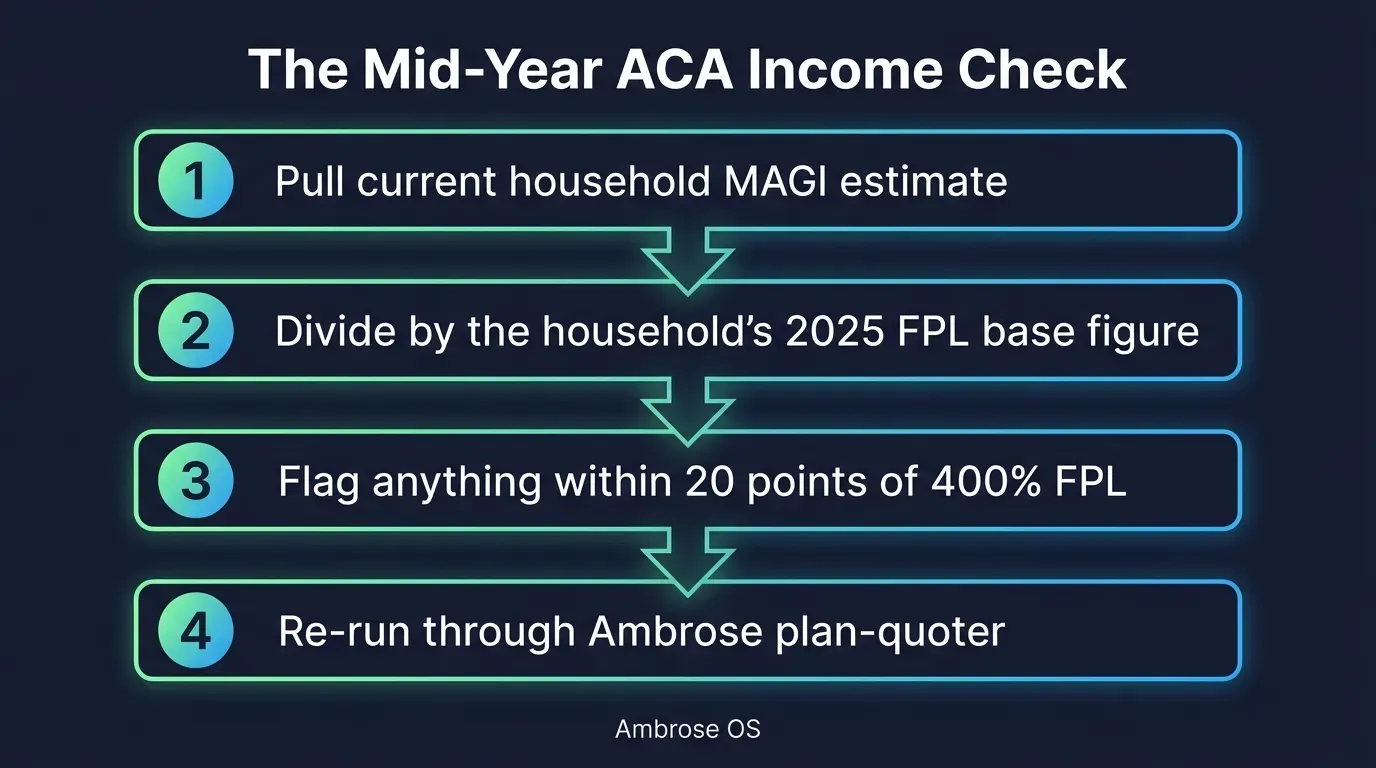
The manual mid-year income check, in full
None of what follows requires a membership, a subscription, or any tool beyond a spreadsheet. This is the actual method, given away completely, because the free version has to work on its own for this post to be worth your time.
Step 1: Pull your ACA book into one list. Every household you enrolled or re-enrolled for 2026 coverage, with the income estimate on file for each, the household size used for that estimate, and the plan they’re on. If your CRM or agency management system doesn’t already track this cleanly, a spreadsheet with one row per household is enough to start.
Step 2: Calculate each household’s percent of FPL using the correct year’s guidelines. For 2026 coverage, that’s the 2025 HHS poverty guidelines table above, not the 2026 table. Divide the household’s income estimate by the 100% FPL figure for their exact household size, then multiply by 100. A household of four estimated at $95,000: $95,000 ÷ $32,150 = 2.955, so 295.5% of FPL. That’s comfortably under the 400% line for now.
Step 3: Flag anything close to the line, or anything that’s moved. Set a working threshold, 15 to 20 percentage points below 400%, so 380-385% FPL and up gets flagged for a check-in even if it hasn’t technically crossed yet. Also flag any household where you have independent reason to think income has changed since enrollment: a text about a new job, a social post about a business doing well, a policy service call that mentioned a raise. You’re not auditing tax returns. You’re using information you already have.
Step 4: Reach out to flagged households with a specific, low-pressure question. Not “has your income changed” as an abstract compliance question, but something concrete: “When we enrolled you in November, we estimated your household income around $X for the year. Is that still roughly accurate, or has anything changed — new job, extra hours, a raise, a side business picking up?” Most people can answer that in one sentence, and the answer tells you immediately whether a deeper look is needed.
Step 5: If the answer suggests a meaningful change, walk through the new number together. Recalculate percent of FPL with the updated estimate. If it’s still comfortably under 400%, note the conversation and move on. If it’s now near or over the line, that’s the conversation in the next section.
Step 6: Document every check, not just the ones that turn something up. A dated note that says “confirmed income estimate still accurate as of [date], client reports no change” protects you exactly as much as a note that catches a real problem, because it shows the check happened as a matter of course, not only when something went wrong.
Run this once at mid-year, not just at renewal
A single pass through your ACA book in July or August catches drift with enough runway left in the year to actually fix it — either by reporting the change to the Marketplace or by having the client set money aside for a known repayment. Waiting until the fall re-shop finds the same problem after most of the plan year's advance credits have already been paid out.
What to tell a client near the cliff, and what to document
If a household’s updated estimate lands at or near 400% FPL, the useful, honest next step is reporting the change to the Marketplace, not waiting for tax time to sort it out. Reporting a household income change through the Marketplace is a documented, timestamped action, and depending on the circumstances it can qualify as a Special Enrollment Period life event, which lets the client adjust their plan or their advance premium tax credit going forward rather than letting the gap between estimate and reality keep growing for the rest of the year.
Be precise about what you’re doing and not doing here. You’re relaying a mechanical fact (report changed income to the Marketplace, and here’s roughly how the math works) and helping the client understand a number they gave you. You are not calculating their tax liability, and a household with complex income, self-employment, multiple jobs, investment income, should be pointed to a tax preparer for the specific reconciliation math on their return. Saying that plainly to the client, and noting that you said it, is part of what keeps this in the “documented and appropriate” category instead of “agent gave tax advice.”
Results may vary, and this is not tax advice
The dollar examples in this article are illustrative arithmetic based on published FPL figures, not a projection of what any specific client owes. Reconciliation outcomes depend on a household's complete tax return. Tech Savvy Insurance is a training and software community, not an insurance company, agency, or law firm, and provides no insurance, legal, tax, or compliance advice. Direct clients with complex income situations to a qualified tax preparer.
Compliance: what the NAIC bulletin and the PHI question mean here
Two compliance threads run through this specific workflow. The first is general to any AI tool touching insurance decisions: the NAIC’s Model Bulletin on the Use of Artificial Intelligence, adopted in December 2023, sets the expectation that AI-assisted decisions still require written governance, human oversight, and documentation an insurance department can request during an exam (NAIC, Insurance Topics: Artificial Intelligence). A growing number of state insurance departments have adopted the bulletin or substantially similar guidance since then; check your own state’s current adoption status directly with your Department of Insurance rather than assuming either way. If you’re using any AI tool, including a general-purpose chatbot, to help estimate or sanity-check a household’s income position, that’s a workflow decision worth having a written note about, the same way you’d document a manual process.
The second thread is about what a household’s income estimate actually is: it’s financial and, indirectly, health-coverage-linked personal data. Pasting a client’s name alongside their income, household composition, and plan details into a general-purpose AI tool with no Business Associate Agreement is exactly the kind of habit that creates exposure nobody notices until it matters. This is the specific problem Ambrose’s PHI Rail is built to address: identifying information is aliased into placeholders before a prompt reaches any destination that isn’t covered by a signed BAA, then re-hydrated on the way back, with every scrub event logged (Ambrose docs, PHI Rail architecture). Ambrose’s own documentation describes this as HIPAA-aware by default, not HIPAA-certified, and that distinction is the accurate one to use.
How Ambrose’s plan-quoter spoke does this in one query
Steps 1 through 3 of the manual process above are a spreadsheet exercise: pull the book, calculate percent of FPL per household, flag what’s close. That’s exactly the kind of repetitive, structured lookup Ambrose is built to take off an agent’s desk, and there’s a specific, named tool for it rather than a generic “AI helps with this” wave.
plan-quoter is a spoke inside Ambrose OS, one of the tool servers an agent or team can dispatch to, with three tools documented: quote_ichra_savings, quote_medicare_options, and quote_aca_marketplace. The one that matters here, quote_aca_marketplace, delivers ACA plan comparisons for a household from four inputs: age, ZIP code, household size, and income tier. Identifiers are scrubbed before the quoting engine sees them, so the tool works from demographics, not a client’s name or Social Security number, and for raw, unscrubbed live marketplace data the same spoke catalog documents a separate marketplace-finder spoke for direct healthcare.gov plan search (Ambrose docs, spoke-plan-quoter). Instead of opening a spreadsheet and computing percent of FPL by hand for every flagged household, you re-run the household through quote_aca_marketplace with the updated income tier and get a current plan and subsidy picture back in one query.
The other piece worth naming is timing. A routine is a scheduled prompt attached to an agent or team, the documented mechanism for running something on a cron schedule with the result posted to Slack, email, or a CRM note without anyone having to remember to trigger it manually (Ambrose docs, Routines). A mid-year book check is a natural fit for that pattern: instead of a July calendar reminder that competes with everything else on your plate, a routine can run the flagged-household pass on a schedule and hand you the list, rather than you hoping you remember to build it.
To be precise about what this is and isn’t: quote_aca_marketplace re-runs the subsidy math from the inputs you give it. It doesn’t independently know that a specific client’s income changed, the same way the manual method above depends on you noticing and asking. What it replaces is the arithmetic and the plan-comparison lookup, not the conversation with the client, which is still the part that actually requires a licensed human.
What you get with a Tech Savvy membership
One Ambrose seat, including plan-quoter, routines, and the PHI Rail architecture referenced in this article, comes included with a Tech Savvy Insurance membership: $97 a month, billed monthly, cancel anytime, with the founding rate locked in while the membership stays active. Usage inside Ambrose itself runs through its own credit ledger with spend caps, so cost stays visible rather than showing up as a surprise line item (Ambrose docs, What is Ambrose). Alongside the seat: weekly Zoom calls with open Q&A and build-with-you sessions, more than 30 hours of recorded training, Meta Ads and marketing training built for this industry, pre-built AI templates and bot deployments, and a free annual in-person member workshop. It’s also an explicit no-recruiting zone, which matters more than it sounds: you can ask a real question about a client’s income estimate without ending up on someone’s downline pitch list, which is not true of most agent Facebook groups.
Close
Run the check yourself first. Every step in the manual walkthrough above works whether you ever join anything or not, and a single afternoon spent flagging the handful of households closest to 400% FPL is worth more than most of what fills an agent’s July calendar. If you’d rather have that pass run on a schedule, with plan-quoter doing the recalculation and a routine handing you the flagged list instead of a spreadsheet you have to remember to open, that’s what the Ambrose seat inside a Tech Savvy membership is built for: https://techsavvyinsurance.com/.
Before you act on any of this
Tech Savvy Insurance is a training and software community, not an insurance company, agency, or law firm, and does not provide insurance, legal, tax, or compliance advice. You are responsible for your own licensure and for complying with all applicable CMS, IRS, HIPAA, state, and carrier regulations. AI-generated outputs may contain errors — always verify before use. Results may vary.
Frequently asked questions
Sources
- IRS — Eligibility for the Premium Tax Credit — irs.gov
- IRS — 2025 Instructions for Form 8962 (Premium Tax Credit) — irs.gov
- Federal Register — Annual Update of the HHS Poverty Guidelines (90 FR 5917, Jan. 17, 2025) — federalregister.gov
- Federal Register (govinfo.gov) — Income Eligibility Guidelines, restating the 2025 HHS poverty guidelines table (90 FR 11810, Mar. 10, 2025) — govinfo.gov
- KFF — What We Know So Far About 2026 ACA Marketplace Enrollment, Premiums, and Deductibles — kff.org
- NAIC — Insurance Topics: Artificial Intelligence (Model Bulletin) — content.naic.org
- Ambrose docs — spoke-plan-quoter — app.hiambrose.com
- Ambrose docs — Routines — app.hiambrose.com
- Ambrose docs — PHI Rail architecture — app.hiambrose.com
- Ambrose docs — What is Ambrose — app.hiambrose.com
Ready to put this into practice?
Join a private community of Health & Life insurance professionals using AI, Meta Ads, and automation to grow — without draining their bank account.
Join Tech Savvy — $97/month