
Your client enrolled in a Chronic Condition Special Needs Plan three weeks ago because she has Type 2 diabetes, which is one of the 15 conditions CMS approved for C-SNP eligibility. You did everything right: you confirmed she had the condition, you submitted the enrollment, and you moved on to the next appointment on your AEP calendar. Then, six weeks after that, you get a chargeback notice for the entire commission, because her primary care provider’s office never returned the verification form, CMS’s clock ran out, and she’s back on Original Medicare. This isn’t a hypothetical. It’s exactly how CMS’s own manual says the process is supposed to work when nobody chases the paperwork, and with C-SNP enrollment up sharply this year, more agents are exposed to it than at any point before. This article covers the actual deadline, the actual CFR citation behind the full-commission clawback, the manual follow-up process that prevents it, and where Ambrose’s medicare-watchdog spoke fits in.
Key takeaways
- A C-SNP enrollee's existing provider must confirm the qualifying chronic condition during the first month of enrollment, or the beneficiary must be disenrolled at the end of the second month (CMS, Medicare Managed Care Manual, Chapter 16b, section 50.2.2.3).
- That disenrollment lands inside the federal three-month "rapid disenrollment" window, and 42 CFR 422.2274(d)(5)(iv)(A) requires the entire compensation to be recovered — not prorated — when rapid disenrollment recovery applies.
- None of the 14 listed exceptions to rapid disenrollment recovery covers a failed C-SNP verification; the beneficiary returns to Original Medicare, not to another special needs plan.
- C-SNP enrollment reached about 1.7 million people in 2026, up 45% from 2025 — an increase of roughly 518,000 enrollees (KFF, published Jun. 5, 2026, updated Jul. 1, 2026).
- The CY2026 national Medicare Advantage initial commission is $694 per member per year (CMS compensation memorandum, Jun. 18, 2025) — the amount actually at risk on an unverified C-SNP enrollment.
What C-SNP verification actually requires
A Chronic Condition Special Needs Plan restricts enrollment to beneficiaries with one or more of 15 severe or disabling chronic conditions CMS approved after convening a panel of clinical experts from the Agency for Healthcare Research and Quality, the CDC, and CMS itself in the fall of 2008. The authority for the list traces to Section 1859(b)(6)(B)(iii) of the Social Security Act and 42 CFR 422.2, which define special needs individuals with severe or disabling chronic conditions as those “who have one or more co-morbid and medically complex chronic conditions that are substantially disabling or life threatening; have a high risk of hospitalization or other significant adverse health outcomes; and require specialized delivery systems across domains of care” (CMS, Medicare Managed Care Manual, Chapter 16b, section 20.1.2).
| # | Condition category | Includes |
|---|---|---|
| 1 | Chronic alcohol and other drug dependence | — |
| 2 | Autoimmune disorders | Polyarteritis nodosa, polymyalgia rheumatica, polymyositis, rheumatoid arthritis, systemic lupus erythematosus |
| 3 | Cancer | Excludes pre-cancer conditions or in-situ status |
| 4 | Cardiovascular disorders | Cardiac arrhythmias, coronary artery disease, peripheral vascular disease, chronic venous thromboembolic disorder |
| 5 | Chronic heart failure | — |
| 6 | Dementia | — |
| 7 | Diabetes mellitus | — |
| 8 | End-stage liver disease | — |
| 9 | End-stage renal disease | Requiring dialysis |
| 10 | Severe hematologic disorders | Aplastic anemia, hemophilia, immune thrombocytopenic purpura, myelodysplastic syndrome, sickle-cell disease |
| 11 | HIV/AIDS | — |
| 12 | Chronic lung disorders | Asthma, chronic bronchitis, emphysema, pulmonary fibrosis, pulmonary hypertension |
| 13 | Chronic and disabling mental health conditions | Bipolar disorders, major depressive disorders, paranoid disorder, schizophrenia, schizoaffective disorder |
| 14 | Neurologic disorders | ALS, epilepsy, extensive paralysis, Huntington's disease, multiple sclerosis, Parkinson's disease, polyneuropathy, spinal stenosis, stroke-related neurologic deficit |
| 15 | Stroke | — |
Enrollment itself can happen on the strength of what the beneficiary tells you, or what a carrier’s intake script captures. That’s not the part CMS is strict about. The strict part comes next: CMS’s manual states plainly that “prior to enrollment, the C-SNP must contact the applicant’s existing provider to verify that the individual has the qualifying condition(s),” and where that pre-enrollment contact hasn’t produced a confirmed answer, “the C-SNP must obtain confirmation of the qualifying chronic condition(s) from the existing provider or a plan provider qualified to confirm the condition during the first month of enrollment” (CMS, Medicare Managed Care Manual, Chapter 16b, section 50.2.2.3). The provider has to be proactively contacted and has to respond, in writing, every time, for every enrollee — not just once at the start of a relationship with the plan.
A fax, not a phone call, is the preferred method
CMS's manual specifically recommends the C-SNP "attempt to obtain eligibility verification information from a beneficiary's existing provider using methods other than phone contact" — a fax or other dated document listing the conditions of interest, with a line for the provider to select the one(s) that apply, is the method CMS describes (CMS, Medicare Managed Care Manual, Chapter 16b, section 50.2.2.3). A verbal confirmation that never gets reduced to a dated, signed document doesn't satisfy this requirement on its own.
The clock that actually runs, and what happens when it expires
This is the part that catches agents off guard, because it isn’t framed as a deadline anywhere in the enrollment paperwork a client signs. It’s a deadline the carrier has to manage on the back end, and it moves whether or not anyone on the agent side is tracking it.
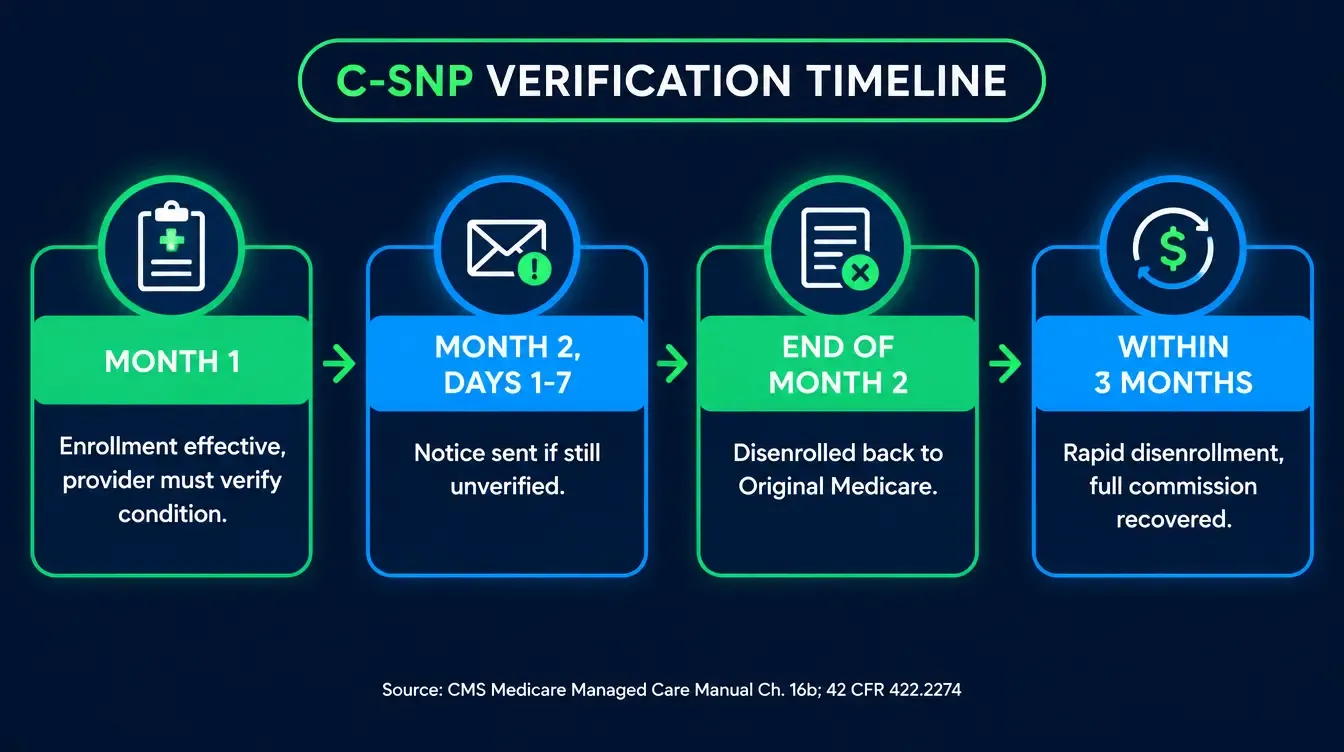
| When | What CMS requires |
|---|---|
| Before enrollment | The C-SNP contacts the applicant's existing provider to attempt to verify the qualifying condition, preferably by fax or dated document rather than phone |
| Month 1 of enrollment | If pre-enrollment verification wasn't obtained, the C-SNP must obtain confirmation from the existing provider or a plan provider during this month |
| Days 1-7 of month 2 | If still unverified, the C-SNP must notify the beneficiary, in writing, that they will be disenrolled at the end of month 2 |
| End of month 2 | The beneficiary is disenrolled from the C-SNP and returns to Original Medicare |
Lay that timeline over the federal rapid disenrollment window and the overlap is immediate. Under 42 CFR 422.2274(d)(5)(ii)(A), a rapid disenrollment is “a beneficiary [who] makes any plan change (regardless of the parent organization) within the first three months of enrollment” (Cornell Law, Legal Information Institute, current eCFR text). An enrollment that becomes effective on the first of a month and gets disenrolled at the end of month two sits inside that three-month window every time the process runs on CMS’s own stated schedule — there’s no scenario in the manual’s own description where a by-the-book verification failure lands outside the rapid disenrollment definition.
The verification deadline and the rapid-disenrollment window aren't two separate risks. They're the same sixty days, looked at from two different regulations.
Mike MooreAnd 42 CFR 422.2274(d)(5)(iv)(A) doesn’t leave room to negotiate the amount: “when rapid disenrollment compensation recovery applies, the entire compensation must be recovered” (Cornell Law, eCFR text of 42 CFR 422.2274). Not a prorated two-months’-worth. Not a partial clawback. The full initial-year commission, recovered, because a provider’s office didn’t return a fax.
Why there’s no exception here
CMS does carve out specific situations where a rapid disenrollment doesn’t trigger recovery. 42 CFR 422.2274(d)(5)(iii) lists them: an enrollment effective October, November, or December with a subsequent change to a January 1 effective date during AEP; gaining other creditable coverage, typically an employer or union plan; moving into or out of an institution; becoming LIS-eligible or dually eligible for Medicare and Medicaid; the plan terminating, non-renewing, or facing a CMS sanction; coordination with Part D enrollment periods; qualifying for another plan based on special needs; auto, facilitated, or passive enrollment; death; moving out of the service area; non-payment of premium; a change in entitlement status; and moving into a 5-star plan, or out of a low-performing plan into one with three stars or more (Cornell Law, eCFR text of 42 CFR 422.2274).
Read that list looking specifically for “lost SNP eligibility because the verification deadline passed,” and it isn’t there. The closest-sounding entry — “qualifying for another plan based on special needs” — describes a beneficiary gaining access to a new special needs plan, which isn’t what happens here. A beneficiary disenrolled for a failed C-SNP verification goes back to Original Medicare. They didn’t qualify for anything new. They lost something, and the clock reset to zero.
This is a description of the federal rule, not of any specific carrier's chargeback practice
Individual carriers and FMOs administer compensation recovery through their own contracts and payment systems, and some may handle edge cases, grace periods, or appeals differently in practice. What's fixed at the federal level is the compensation framework in 42 CFR 422.2274 itself. Confirm how your specific carrier agreements implement it — this article describes the regulatory floor, not your contract's exact mechanics.
A worked example: the same enrollment, two different Mays
Abstract deadlines are easy to nod along with and easy to misjudge in practice, so run one scenario against both outcomes.
A client enrolls in a C-SNP effective March 1, qualifying on Type 2 diabetes. You send the verification fax to her endocrinologist’s office on March 3. In the first version of this story, the office signs and returns it on March 19 — inside the first month of enrollment, as CMS requires. Nothing else happens. The client stays enrolled, your commission is never at risk, and you likely never think about this specific file again.
In the second version, the same fax sits in the same office’s inbox behind a backlog of other requests. You don’t follow up, because nothing on your calendar told you to. April arrives with no verification on file. Under CMS’s rule, the carrier now has to notify the beneficiary within the first seven calendar days of April that she’ll be disenrolled at the end of the month if the form doesn’t show up — a notice that goes to her, not to you, so you may not even know it was sent. April 30 passes. She’s disenrolled back to Original Medicare, effective that date. The enrollment ran from March 1 to April 30: two months, squarely inside the three-month rapid disenrollment window defined at 42 CFR 422.2274(d)(5)(ii)(A). The full initial-year commission is recovered.
| Step | Verification returned on time | Verification never returned |
|---|---|---|
| Enrollment effective | March 1 | March 1 |
| Verification fax sent | March 3 | March 3 |
| Day-20 follow-up call | Not needed — form already back | Skipped |
| Outcome | Signed form received March 19; enrollment stands | Disenrolled April 30; commission fully recovered |
The only variable that changed between these two outcomes is whether anyone called the provider’s office back around day 20. Nothing about the client’s eligibility changed, nothing about the sale changed, and nothing about your compliance with the enrollment process itself changed. The entire difference is a single follow-up call that either happened or didn’t.
What this is actually worth, and why it’s a bigger number than it used to be
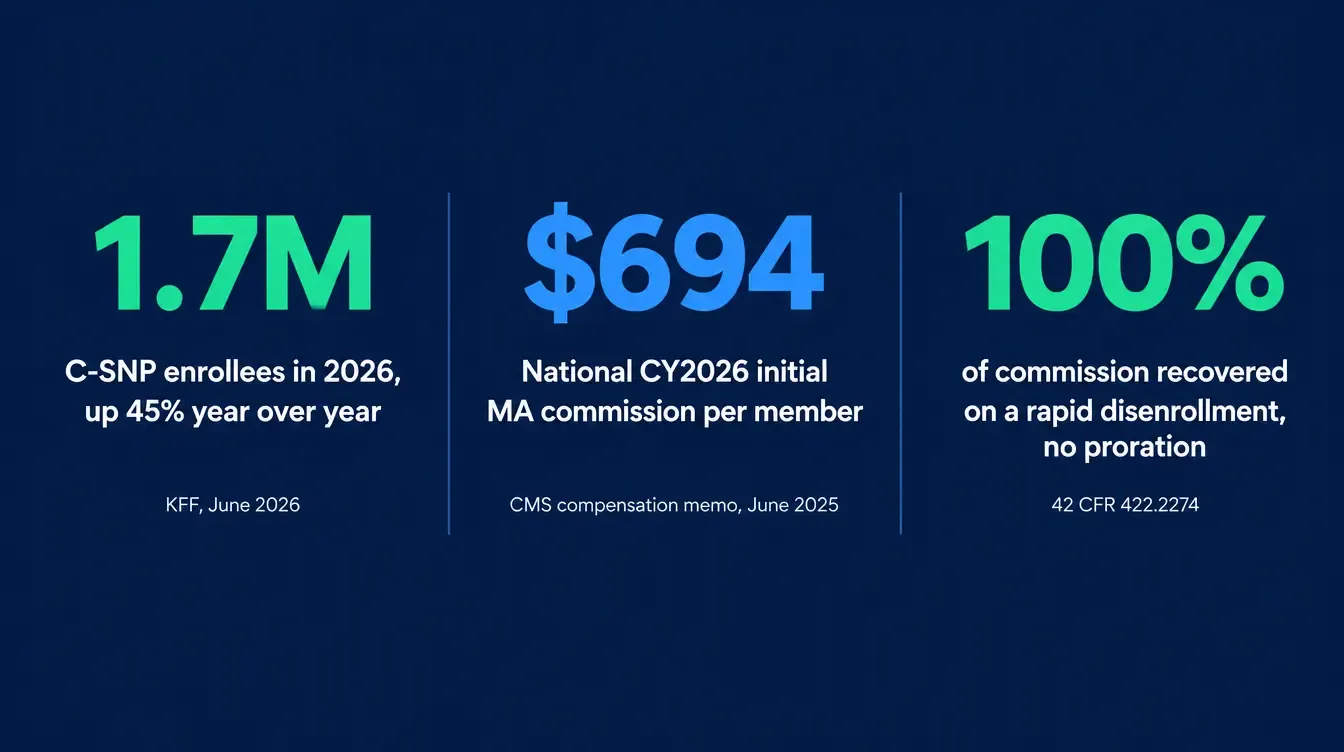
C-SNP enrollment isn’t a niche corner of the Medicare Advantage market anymore. KFF’s 2026 Medicare Advantage enrollment brief puts C-SNP enrollment at about 1.7 million people this year, 45% higher than 2025 — an increase of roughly 518,000 enrollees in a single year — with nearly all of that growth, 97%, concentrated in plans built for diabetes or cardiovascular conditions specifically (KFF, Medicare Advantage in 2026: Enrollment Update and Key Trends, published Jun. 5, 2026, updated Jul. 1, 2026). More C-SNP sales means more enrollments running through the exact 60-day verification clock described above, and more agents exposed to the chargeback if that clock isn’t actively managed.
The dollar amount at risk climbed too. CMS’s Contract Year 2026 Agent and Broker Compensation memorandum, signed by Kathryn A. Coleman, Director of the Medicare Drug & Health Plan Contract Administration Group, on June 18, 2025, sets the national Medicare Advantage initial-year compensation ceiling at $694 per member per year, with renewal-year compensation capped at 50% of that fair market value amount, or $347 (CMS compensation memorandum, Jun. 18, 2025). Higher-cost-of-living regions run above that: $781 initial in Connecticut, Pennsylvania, and the District of Columbia; $864 in California and New Jersey; $474 in Puerto Rico and the U.S. Virgin Islands.
CY2026 Medicare Advantage initial-year compensation by region
Fair market value ceiling per member, per CMS's Contract Year 2026 Agent and Broker Compensation memorandum (Jun. 18, 2025). This is the full amount a rapid disenrollment recovers — none of it is prorated.
Source: CMS, Contract Year 2026 Agent and Broker Compensation Rates memorandum (Kathryn A. Coleman, Director, Jun. 18, 2025).
Run the math on a book with even a modest number of C-SNP sales in a given AEP. If one in ten C-SNP enrollments nationally runs into a verification that doesn’t land in time — and nothing about a provider’s office being slow, short-staffed, or unresponsive during the exact weeks everyone else is also sending AEP paperwork is unusual — that’s real recovered commission on a book that otherwise looked clean at the point of sale.
The manual process, given away completely
None of what follows requires a membership, a CRM, or any piece of software. It requires a habit, applied to every C-SNP enrollment, every time.
Identify the treating provider at the point of sale
Get the name, phone, and fax of the specific provider who treats the qualifying condition — not just "my doctor," but the cardiologist, endocrinologist, or primary care provider whose signature will actually need to appear on the verification document.
Send the verification request the same week, in writing
CMS's own guidance favors a fax or dated document over a phone call. Send it immediately after enrollment, not after a follow-up call reveals nothing's moved — the first-month deadline starts on day one, not whenever someone remembers to send the form.
Set your own internal deadline at day 20, not day 30
The federal deadline is "during the first month of enrollment." Give yourself a buffer: if the signed form hasn't come back by roughly day 20, that's your trigger to follow up directly, not wait and hope.
Call the provider's office directly if the fax goes unanswered
Office staff lose faxes. A short call confirming receipt and asking when the provider will sign it is often the difference between a form that gets done and one that sits in a stack until it's too late.
Keep a dated log of every attempt
The date you sent the request, the date of any follow-up call, and the date verification came back (or didn't) is the record that shows you did your part, whatever happens with the provider's office.
If month one ends with no verification, call the client before the carrier's notice arrives
A client who hears "your plan requires a form from your doctor, and we're following up" from you, before a disenrollment notice shows up in the mail, is a client who stays calm and helps you chase it down. One who hears about it cold, from a letter, is a client who assumes something went wrong on your end.
This is a tracking problem more than a knowledge problem
Most agents who get burned by this already know the rule exists in the abstract. What breaks down is tracking it across a book of twenty, forty, or a hundred C-SNP enrollments during the exact weeks of the year when everything else is also on fire. A spreadsheet with an enrollment date, a "day 20 follow-up" column, and a verification-received checkbox is the whole system, and it costs nothing to build.
Where the manual version breaks down at scale
A single verification follow-up is a five-minute task. The problem is running that task reliably across every C-SNP sale on a growing book, during AEP, when a hundred other things are also competing for the same week. A spreadsheet works until someone forgets to open it, or until a follow-up call that should’ve happened on day 20 happens on day 35 instead, past the point where it still matters.
A spreadsheet and a reminder you set yourself
- Works as long as someone remembers to check it every week during AEP
- Easy to lose track of once a book has more than a handful of C-SNP sales running at once
- No automatic flag when a provider's office goes quiet
medicare-watchdog's book-wide scan, on a schedule
- medicare_scan_book is documented to identify risk signals across a Medicare book of business (Ambrose docs, spoke-medicare-watchdog)
- Runs on federal CMS data, with internal cross-referencing against vault records, no client identifiers sent externally (Ambrose docs, spoke-medicare-watchdog)
- A Routine can re-run the scan on a cron schedule and post results to Slack (Ambrose docs, Routines)
How Ambrose’s medicare-watchdog spoke fits, honestly
Here’s the part worth being precise about instead of oversold. Ambrose’s documentation describes medicare-watchdog as a free spoke built for “scheduled MAPD/PDP/Med Supp intelligence — cost hikes, plan discontinuations, network changes, Star Ratings, rate filings,” running on federal CMS data with no client identifiers transmitted externally (Ambrose docs, spoke-medicare-watchdog). Its documented tools are medicare_scan_book, which identifies risk signals within a book of business; medicare_check_plan, which retrieves status and cost information for specific plans; medicare_star_diff, which compares Star Rating changes year over year; and medicare_rate_filing, which retrieves current rate filing data (Ambrose docs, spoke-medicare-watchdog).
What’s not documented, and what this article isn’t going to claim, is a feature that tracks an individual enrollee’s C-SNP verification status against the specific first-month and second-month deadlines described above. That level of plan-administration detail isn’t the kind of thing medicare_scan_book’s current description confirms it does. What is a fair, honestly-stated use of the spoke: medicare_scan_book is built to surface risk signals across a book of business, and a book with recent C-SNP enrollments sitting past their verification window is exactly the kind of thing a risk-signal scan is designed to catch, run often enough to matter. Paired with a scheduled Routine — which Ambrose’s documentation describes as a cron-scheduled prompt attached to an agent or team, with an output sink like Slack, used for examples including “weekly renewal scans targeting a team to identify at-risk clients” (Ambrose docs, Routines) — the honest mechanism here is a recurring, automated check that replaces a human remembering to open a spreadsheet, not a dedicated C-SNP verification tracker that doesn’t exist yet.
| Manual habit | Ambrose equivalent |
|---|---|
| Remembering to check a spreadsheet of open C-SNP verifications | A scheduled Routine running medicare_scan_book on a cron, output to Slack (Ambrose docs, Routines; spoke-medicare-watchdog) |
| Digging through a book by hand to find who's approaching a deadline | medicare_scan_book's documented purpose: identifying risk signals within a Medicare book of business (Ambrose docs, spoke-medicare-watchdog) |
| Keeping a client's name and diagnosis out of a general AI tool | medicare-watchdog runs on federal data with no client identifiers sent externally; the PHI Rail aliases identifiers before anything reaches a non-BAA destination (Ambrose docs, spoke-medicare-watchdog; PHI Rail) |
This replaces forgetting to check, not the follow-up call itself
A scan surfacing a risk signal doesn't fax a provider's office or get a form signed. It tells you where to spend the next follow-up call instead of guessing or checking every file. The provider relationship and the actual chase are still yours to run — this shortens the part where nobody realized a window was closing until it already had.
Compliance notes before you rely on any of this
This article describes a plan-administration and compensation rule, not Medicare marketing content, but two things are worth stating plainly because AI tools and C-SNP sales both touch sensitive territory. First, if any part of your C-SNP follow-up process — a tracking spreadsheet, a reminder system, an AI tool drafting a letter to a provider’s office — involves a client’s name alongside their diagnosis, treat that as PHI the moment it leaves a HIPAA-covered system. Never paste a beneficiary’s name, diagnosis, or plan details into a general-purpose AI tool that doesn’t have a Business Associate Agreement with your agency; that’s precisely the gap Ambrose’s PHI Rail is built to close, aliasing identifiers before anything reaches a non-BAA destination (Ambrose docs, PHI Rail).
Second, the NAIC’s AI Model Bulletin, adopted in December 2023, sets the governing expectation for any AI tool touching this kind of workflow: a written program for responsible AI use, human oversight of what the system produces, documentation a regulator could request, and accountability for third-party AI vendors (NAIC, Insurance Topics: Artificial Intelligence). A risk-signal scan is an input to your own review of a book of business, not a replacement for actually confirming a specific client’s verification status before you tell them anything about where it stands.
Tech Savvy Insurance is not a law firm, an insurance company, or an agency
Tech Savvy Insurance is a training and software community. It does not provide insurance, legal, tax, or compliance advice. You are responsible for your own licensure and for complying with all applicable CMS, HIPAA, state, and carrier rules, including your specific carrier and FMO agreements, which may implement compensation recovery differently than the federal floor described here. AI-generated outputs, including any Ambrose scan result, may contain errors — always verify against the current regulatory text and your carrier's own compliance guidance. Results may vary.
What you get by joining
One Ambrose seat, including medicare-watchdog and Routines, comes with a Tech Savvy Insurance membership: $97 a month, billed monthly, cancel anytime, founding rate locked in while the membership stays continuously active. Alongside the seat: weekly Zoom calls with open Q&A and build-with-you sessions, more than 30 hours of recorded training updated monthly, Meta Ads and AI marketing training built for health and life agents, pre-built AI templates and bot deployments, and a free annual in-person member workshop — in an explicit no-recruiting zone, so you can ask a real question about a chargeback without getting pitched a downline an hour later.
Ambrose usage is separate from the $97 seat
The membership includes one Ambrose seat, and usage inside Ambrose is billed separately from the $97/month membership fee — don't assume everything described here is free indefinitely. See the full Spokes catalog for what else medicare-watchdog's sibling spokes cover.
Everything above — the 15 conditions, the exact timeline, the CFR citation on recovery, the manual follow-up system — works whether you ever join anything or not. Build the spreadsheet this AEP and run it by hand on every C-SNP sale, or let a scheduled scan flag the book for you.
Build your C-SNP verification tracker before AEP opens
Open Enrollment runs October 15 through December 7 this year (CMS.gov, Medicare Open Enrollment partner resources). Add one column to whatever you already use to track enrollments: verification sent, verification received, day-20 follow-up done. That's the whole manual system, no membership required. If you'd rather have a scheduled scan flag it for you and watch the result land in Slack, one Ambrose seat comes with the Tech Savvy membership.
Join Tech Savvy — $97/monthRelated reading: our guide to re-shopping your Medicare book before AEP for the broader annual review process, our breakdown of Medicare Advantage commission cuts for what else can move the number on a check, and our walkthrough of Medicare Special Election Periods, including the chronic condition SEP that gets someone into a C-SNP in the first place.
The close
CMS built the C-SNP verification requirement to confirm that someone actually has the condition the plan is designed around, and that’s a reasonable thing for a federal program to check. The part that catches agents is that the deadline lives entirely in the carrier’s back-office process, nobody tells the client it’s running, and the commission recovery rule that follows a missed deadline doesn’t prorate. Fifteen conditions, a first-month verification window, a seven-day notice, a second-month disenrollment, and a full clawback under 42 CFR 422.2274 — that’s the entire mechanism, and now you have it with the actual citations instead of a secondhand version. Track it by hand this AEP, or let a scheduled scan do the watching. This is the kind of thing that comes up on a Tuesday call the week someone’s first chargeback notice lands: $97 a month, cancel anytime, and nobody will pitch you a downline: https://techsavvyinsurance.com/.
Before you rely on any date or figure in this article
Tech Savvy Insurance is a training and software community, not an insurance company, agency, or law firm, and does not provide insurance, legal, tax, or compliance advice. You are responsible for your own licensure and for complying with all applicable CMS, HIPAA, state, and carrier rules. AI-generated outputs may contain errors — always verify. Results may vary.
Frequently asked questions
Sources
- CMS — Chronic Condition Special Needs Plans (C-SNPs) — cms.gov
- CMS — Medicare Managed Care Manual, Chapter 16b: Special Needs Plans (Rev. 101, Feb. 28, 2014) — cms.gov
- Cornell Law, Legal Information Institute — 42 CFR 422.2274, current eCFR text — law.cornell.edu
- CMS — Contract Year 2026 Agent and Broker Compensation Rates memorandum (Kathryn A. Coleman, Director, Jun. 18, 2025) — medicareful.ritterim.com
- KFF — Medicare Advantage in 2026: Enrollment Update and Key Trends (published Jun. 5, 2026, updated Jul. 1, 2026) — kff.org
- CMS — Medicare Open Enrollment partner resources (AEP dates) — cms.gov
- NAIC — Insurance Topics: Artificial Intelligence (Model Bulletin, adopted Dec. 2023) — content.naic.org
- Ambrose docs — spoke-medicare-watchdog — app.hiambrose.com
- Ambrose docs — Routines — app.hiambrose.com
- Ambrose docs — PHI Rail — app.hiambrose.com
Ready to put this into practice?
Join a private community of Health & Life insurance professionals using AI, Meta Ads, and automation to grow — without draining their bank account.
Join Tech Savvy — $97/month