
Yes, insurance agents can ask clients for Google reviews — CMS, the FTC, NAIC, and Google all allow it. What trips agents up isn’t the asking, it’s four separate rulebooks that overlap on the same five-star widget: CMS’s testimonial rule for anything that names a specific Medicare plan, the FTC’s 2024 reviews rule and its 2023 Endorsement Guides for every business in the country, NAIC’s unfair trade practices model for insurance advertising specifically, and Google’s own platform policy on top of all three. This article maps exactly what each one requires, the one phrasing mistake that turns a harmless review request into a CMS-regulated testimonial, and the manual review-request workflow that stays clear of all four — plus what Ambrose’s channel-bridge spoke actually does if you’d rather not run it by hand.
Key takeaways
- The FTC's Trade Regulation Rule on the Use of Consumer Reviews and Testimonials (16 CFR Part 465) took effect October 21, 2024, and bans conditional incentivized reviews, undisclosed insider reviews, and review suppression by legal threat (Federal Register, 89 FR 68034; FTC, Aug. 14, 2024).
- Violations of FTC trade regulation rules carry civil penalties up to $53,088 per violation — the FTC's own most recently published figure, in effect since January 17, 2025 (FTC, 2025 inflation adjustment).
- CMS's testimonial rule (MCMG Section 30.8) only governs reviews that name a specific Plan's or Part D sponsor's product and were written by someone enrolled in it at the time — a review about your service as an agent generally sits outside it (CMS, MCMG, Sept. 5, 2018).
- "Review gating" — asking only happy clients, or routing unhappy ones away from Google — is explicitly against Google's own Business Profile policy, independent of the federal rules (Google, Business Profile policies).
- 42% of consumers now trust online reviews as much as a personal recommendation from a friend or family member, down from 79% in 2020 — a trust decline BrightLocal attributes partly to fake and incentivized reviews (BrightLocal, Local Consumer Review Survey 2025).
The pain: one well-meant review request, four ways to get it wrong
Picture the moment this usually happens. A Medicare Advantage client just finished a smooth AEP enrollment, she’s thrilled, and on the way out the door you say, “If you have a minute, I’d love a Google review — and if you mention the great premium on this plan, that’d help other folks find us.” You’ve just, in one sentence, invited a testimonial that names a specific plan’s benefit, from someone you have no way to confirm will still be enrolled by the time she posts it, with no paid-endorsement disclosure attached because none is owed — except CMS’s rule doesn’t care that you didn’t pay her. It cares that the review names the plan.
Or picture the more common version: you ask for reviews, but only from clients who seem happy. A client who called twice with a billing complaint doesn’t get the text with the review link. Nothing about that feels like breaking a rule — it feels like common sense, not wanting to invite a negative review. Google’s own policy calls it review gating, and bans it outright, specifically because it’s the version of “optimizing” your reviews that every well-meaning local business owner does without realizing it’s prohibited.
Or the gift-card version: “Leave us a review and we’ll enter you in a drawing for a $50 gift card.” Common in general local-business marketing for a decade. As of October 2024, it’s a federal violation if the reward is in any way conditioned on the review being positive — and a drawing tied to “leaving a review” at all sits close enough to the line that most compliance counsel now advise against it entirely.
None of these are malicious. They’re the default instincts of a good salesperson trying to build a reputation, running headlong into four different rulebooks that were never written with each other in mind, let alone with a licensed insurance agent’s specific situation in mind.
Why it happens: four rulebooks, one star-rating widget
CMS’s Medicare Communications and Marketing Guidelines (MCMG) only cover testimonials about a specific plan. Section 30.8 requires that “the speaker must identify the Plan’s/Part D sponsor’s product or company by name,” that “Medicare beneficiaries endorsing or promoting a Plan/Part D sponsor must be enrolled in the Plan/Part D sponsor at the time the endorsement or testimonial was created,” that any paid endorsement be clearly labeled as such, and that a paid actor portraying a situation be labeled “Paid Actor Portrayal” (CMS, MCMG, Sept. 5, 2018). This rule exists to govern materials plans and their downstream TPMOs produce about plan benefits — it was never written with an organic Google review in mind, but a review that names a plan and praises its benefit structure walks straight into its definition of a testimonial anyway.
The FTC’s rules apply to every business in the country, insurance included, and they’re the newest and least familiar of the four. The Endorsement Guides (16 CFR Part 255), last revised in 2023, require that “if there’s a connection between an endorser and the marketer that a significant minority of consumers wouldn’t expect and it would affect how they evaluate the endorsement, that connection should be disclosed clearly and conspicuously” (FTC, Endorsement Guides FAQ). The newer Trade Regulation Rule on the Use of Consumer Reviews and Testimonials (16 CFR Part 465) went further in 2024: it’s an actual rule, not just guidance, with real civil penalties attached, and it specifically targets fake reviews, reviews from people with no real experience with the business, conditional incentivized reviews, undisclosed insider reviews, purchased fake social media engagement, and review suppression by legal threat (FTC, Aug. 14, 2024; Federal Register, 89 FR 68034, effective Oct. 21, 2024).
NAIC’s Unfair Trade Practices Act model law was written for insurance advertising specifically, decades before anyone was leaving Google reviews. Its Section 4.B, “False Information and Advertising Generally,” prohibits making, publishing, or placing before the public any advertisement, announcement, or statement with respect to the business of insurance that is untrue, deceptive, or misleading (NAIC, Model #880, Spring 2024 edition). Most states have adopted some version of this model act, and a misleading insurance-specific review or response can trigger it independent of anything federal.
Google’s own platform policy sits on top of all three, and it’s the one most agents have actually read the least. It permits encouraging genuine reviews without incentives, and explicitly prohibits offering payment, discounts, or free goods for a review; requiring or pressuring customers to leave ratings while on the premises; and — the gating problem from the opening story — selectively soliciting positive reviews from certain customers while routing others away (Google, Business Profile policies).
None of these four rulebooks mention each other. A review that's perfectly fine under three of them can still violate the fourth.
Mike MooreWhat it costs: a real federal penalty, and a slower-moving cost in trust
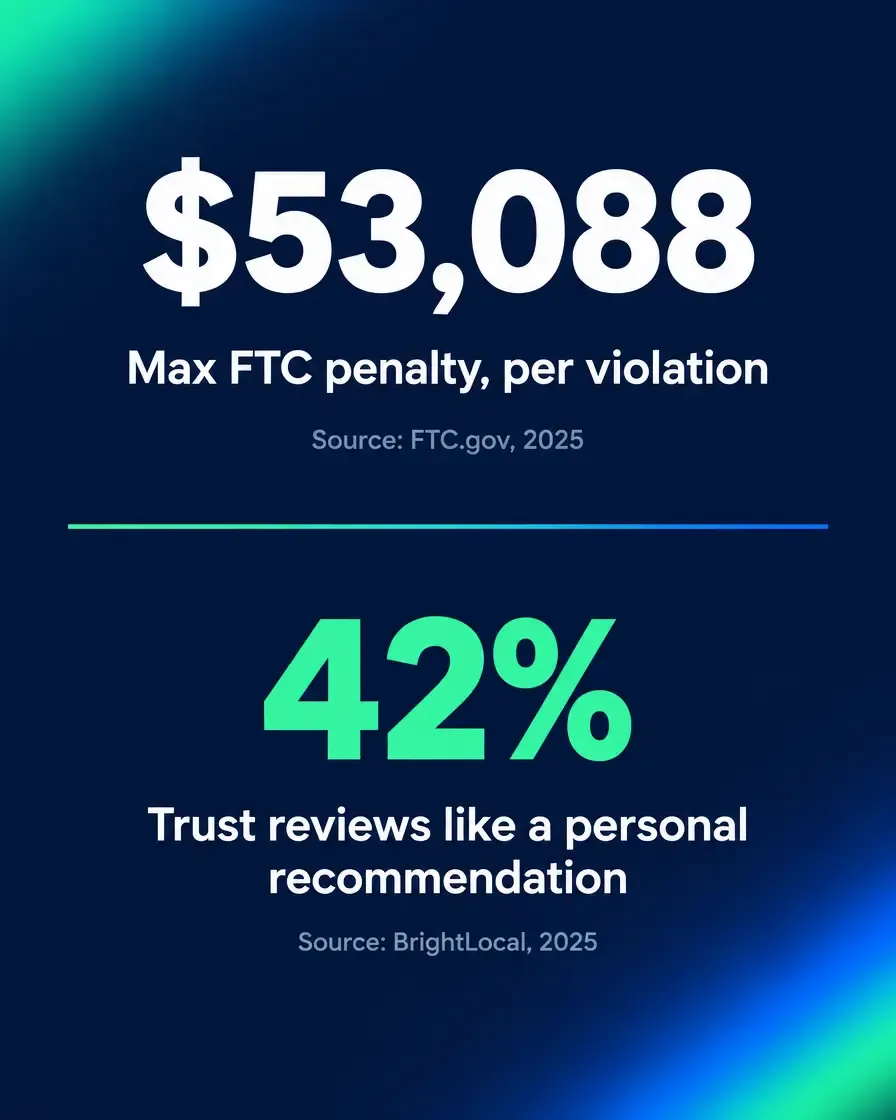
The federal penalty is the number that gets an agency owner’s attention, and it’s worth being precise about what it actually measures: $53,088 is the FTC’s current maximum civil penalty per violation of a trade regulation rule, the category the 2024 reviews rule falls under (FTC, inflation-adjusted penalty amounts, effective Jan. 17, 2025). The FTC did not publish a new inflation adjustment for 2026, so this remains the agency’s most recently confirmed figure. “Per violation” is the operative phrase for a small agency: a pattern of gating requests to happy clients only, or an undisclosed review from an office manager, isn’t automatically capped at one fine — a pattern of conduct can be charged as a pattern of violations.
Consumer trust in online reviews is falling, not rising
Share of US consumers who say they trust online reviews as much as a personal recommendation from a friend or family member
Source: BrightLocal, Local Consumer Review Survey 2025, published Jan. 29, 2025 (n=1,026 US adult consumers, SurveyMonkey panel). Fetched October 2026.
That decline is the slower, quieter cost. BrightLocal’s own 2025 survey, run on a panel of 1,026 US adult consumers, found trust in reviews dropping from 79% in 2020 to 42% in 2025 — and just 4% of consumers say they never read reviews at all before choosing a local business, meaning the overwhelming majority are still looking, they’re simply more skeptical of what they find (BrightLocal, Local Consumer Review Survey 2025). Every agency that gates its requests, every undisclosed employee review, every suspiciously uniform batch of five-star ratings that all mention the same plan name in the same week, adds to the exact skepticism that survey is measuring. The federal rule didn’t create that distrust. It’s a response to it, and it’s now enforceable.
How to fix it: a manual workflow that clears all four rulebooks
Nothing below requires software, a membership, or anything beyond a client list and five minutes of planning. This is the complete method — not a preview of a paid version.
Step 1: Decide which bucket a review request falls into, before you ask
| What the review is about | Governing rule(s) | Key requirement |
|---|---|---|
| Your service as an agent ("Mike made this easy to understand") | FTC Endorsement Guides, FTC Reviews Rule, Google policy, NAIC Model #880 | Genuine, ungated, unincentivized, truthful — no CMS testimonial submission needed |
| A specific plan's benefits or premium ("the $0 premium plan saved me $200/mo") | CMS MCMG Section 30.8, plus everything in the row above | Reviewer must be a current enrollee when written; counts as a testimonial under CMS's definition |
| A review from an employee, family member, or anyone you've paid | FTC Endorsement Guides, FTC Reviews Rule | Material connection must be clearly and conspicuously disclosed, or don't disseminate it |
| A response to a negative review | FTC Reviews Rule, NAIC Model #880 | No legal threats or intimidation to force removal; no misrepresenting what reviews exist |
The practical rule that falls out of that table: ask clients to talk about working with you, never about a specific plan’s premium, deductible, or benefit structure. “How was the process? How did [agent name] make it easier?” produces exactly the kind of review that clears CMS’s testimonial definition entirely, because it’s never about the plan.
Step 2: Ask everyone, the same way, every time
Pick a single trigger point — enrollment confirmed, policy issued, a successful renewal call — and send the identical request to every client who hits it, not a curated subset. Do not pre-screen with “how was your experience?” before deciding whether to send the review link; that’s the exact mechanism Google’s policy prohibits. If a client’s experience was genuinely rocky, the review they leave is information you need anyway, and a pattern of 5.0-star ratings with zero variance is itself a signal that reads as manufactured to anyone looking closely — including, eventually, regulators.
Step 3: Write the ask once, and reuse it verbatim
A message like this clears every rule in the table above:
“Thanks for trusting me with your coverage this year. If you have two minutes, I’d really appreciate a quick Google review about your experience working with me — here’s the link: [your review link].”
Note what it doesn’t do: it doesn’t mention a plan name, a premium, or a benefit. It doesn’t offer anything in exchange. It doesn’t ask the client to say anything specific. Send it by text or email within a day or two of the triggering event — not mid-call, and never folded into a Scope of Appointment conversation — using the same wording for every client, every time.
Don't let a client's own words put you in CMS's testimonial category
You can't fully control what a client writes once they're on Google's site. If a review comes back naming a specific plan's benefits, you generally can't edit or remove it yourself — but you also don't need to amplify it. Don't screenshot it into a Facebook ad or a website testimonial section, which would turn a stray organic review into a marketing piece you're now responsible for under CMS's rule, including the current-enrollee and paid-endorsement requirements. Leave it where it is.
Step 4: Never incentivize, and disclose every insider review
If you want to thank clients for their business, do it unconditionally — a holiday card, a small gift sent to the whole client list regardless of who has or hasn’t left a review. The moment a reward is tied to the act of reviewing, or especially to a positive review, it falls under the FTC’s conditional-incentive ban (FTC, Aug. 14, 2024). If your office manager, your spouse, or a close friend wants to leave a genuine review, that’s allowed — but the review needs a clear disclosure of the relationship, something as simple as “I work at this agency” in the text, per the FTC’s Endorsement Guides (FTC, Endorsement Guides FAQ, revised 2023).
Step 5: Handle a negative review by responding, not threatening
Reply professionally, acknowledge the specific issue if you can without disclosing anything protected, and move on. Do not send a cease-and-desist letter or threaten legal action to pressure a client into removing an accurate negative review — that’s precisely the review-suppression conduct the FTC’s 2024 rule targets (FTC, Aug. 14, 2024). A public, calm, professional response to a bad review is also, in practice, what most prospective clients actually judge you on.
A test you can run this week
Pull your last twenty Google reviews. Count how many name a specific plan, premium, or benefit by name. Any that do are testimonials under CMS's definition whether you intended that or not — note it, and adjust your ask script going forward so future reviews stay about your service instead.
Everything above works whether you ever touch Ambrose or join anything. It’s a script and a habit, not a purchase.
How Ambrose’s channel-bridge spoke removes the temptation to gate
The manual version works, and it’s also exactly the kind of task that quietly drifts back toward gating — a busy week, a client who seemed a little difficult, a “I’ll get to the rest later” that never happens for the clients who complained. Ambrose’s channel-bridge spoke is documented as “the single place messages actually leave your account,” exposing two tools: bridge_send_email and bridge_send_sms, which dispatch outbound email through Gmail, a GHL conversation, or direct SMTP, and SMS through Twilio or a GHL conversation (Ambrose docs, spoke-channel-bridge, fetched September 2026). It runs in drafts mode by default — messages sit for review before auto-send is deliberately enabled at the agent or team level — which means a human still sees and approves the wording before anything goes out.
Paired with the ghl spoke, documented as giving an agent access to the “full GoHighLevel surface” (Ambrose docs, Spokes, fetched September 2026), an agency can configure the review request to fire automatically off a single trigger — a pipeline stage change to “Policy Issued,” for example — rather than off a human remembering, or deciding case by case, who seems happy enough to ask.
The five-step method from this article
- You remember to send the request after every closed deal
- You have to resist the urge to skip a difficult client
- Wording stays consistent only if you reuse the same script every time
- Works today, in any CRM, at zero cost
The same request, fired by a pipeline trigger
- A GHL stage change fires bridge_send_sms or bridge_send_email automatically
- Every client at that stage gets the identical message — nothing to selectively skip
- Drafts mode means a human still approves wording before auto-send is enabled
- Outbound bodies route through the PHI Gateway when the destination isn't on the BAA allowlist
Be precise about what this is and isn’t. Channel-bridge doesn’t know whether a message you draft names a specific plan’s benefits — that judgment, and staying inside CMS’s testimonial definition, is still yours to apply when you write the message template. What it does is remove the one failure mode that’s actually mechanical: a human quietly deciding, client by client, who gets asked. A trigger-based send asks everyone who hits the stage, every time, which is the literal definition of not gating.
What you get by joining
One Ambrose seat comes with a Tech Savvy Insurance membership: $97 a month, billed monthly, cancel anytime, founding rate locked in while the membership stays active. That includes weekly Zoom calls with open Q&A and build-with-you sessions, 30-plus hours of recorded training, pre-built AI templates and bot deployments, Meta Ads and marketing training built for this industry specifically, and a free annual in-person member workshop — plus an explicit no-recruiting rule, so a question about setting up a review-request trigger doesn’t turn into someone else’s downline pitch.
Ambrose usage is separate from the $97 seat
The membership includes one Ambrose seat; usage inside Ambrose runs through its own credit ledger with spend caps, so cost stays visible instead of showing up as a surprise. See the full Spokes catalog for what channel-bridge sits alongside.
Know which bucket a review falls into
Service reviews and plan-specific testimonials answer to different rules.
Ask everyone, the same way
No pre-screening, no gating — Google's policy bans both outright.
Never incentivize a review
Conditional rewards are now a federal violation, not just bad practice.
Disclose every insider review
Employee, family, or paid reviews need a clear, visible disclosure.
Respond, don't suppress
Legal threats to remove a true negative review are explicitly banned.
Fire the ask from a pipeline trigger
channel-bridge plus ghl removes the human decision to skip someone.
Stop guessing which rulebook applies
The manual workflow above works whether you ever join anything or not. If you'd rather have the trigger-based version set up on your own GoHighLevel account, with someone watching your screen, one Ambrose seat comes with the Tech Savvy membership.
Join Tech Savvy — $97/monthThe close
A review request is one sentence, sent at the right moment, about the right thing — and that’s genuinely all it takes to stay clear of CMS, the FTC, NAIC, and Google at the same time. Write the script once, point it at your service instead of a plan’s benefits, and send it to every client who closes, not just the ones who seemed happiest on the call. If you’d rather have that trigger built into your CRM instead of relying on memory, that’s the kind of thing we work through on a Tuesday call in the Tech Savvy community — $97 a month, cancel anytime, and nobody will pitch you a downline: https://techsavvyinsurance.com/.
Before you change your review request process
Tech Savvy Insurance is a training and software community, not an insurance company, agency, or law firm, and does not provide insurance, legal, tax, or compliance advice. Whether a specific review, response, or incentive complies with CMS's marketing rules, the FTC's rules, your state's adoption of the NAIC's Unfair Trade Practices Act, or Google's policies is a judgment call you and, where appropriate, your own counsel need to make for your specific situation. You are responsible for your own licensure and for complying with all applicable CMS, HIPAA, state, and carrier requirements. AI outputs may contain errors — always verify — and never paste a client's protected health information into a general-purpose AI tool without a Business Associate Agreement in place. Results may vary.
Frequently asked questions
Sources
- CMS — Medicare Communications and Marketing Guidelines (MCMG), Section 30.8 Product Endorsements/Testimonials, Sept. 5, 2018 — cms.gov
- FTC — Federal Trade Commission Announces Final Rule Banning Fake Reviews and Testimonials (Aug. 14, 2024) — ftc.gov
- Federal Register — Trade Regulation Rule on the Use of Consumer Reviews and Testimonials, 89 FR 68034 (published Aug. 22, 2024, effective Oct. 21, 2024) — federalregister.gov
- FTC — Endorsement Guides: What People Are Asking (revised 2023) — ftc.gov
- FTC — Publishes Inflation-Adjusted Civil Penalty Amounts for 2025 (effective Jan. 17, 2025) — ftc.gov
- Google — Business Profile review policies — support.google.com
- NAIC — Unfair Trade Practices Act (Model #880), Section 4, Spring 2024 edition — content.naic.org
- BrightLocal — Local Consumer Review Survey 2025 (published Jan. 29, 2025) — brightlocal.com
- Ambrose docs — spoke-channel-bridge — app.hiambrose.com
- Ambrose docs — Spokes (catalog) — app.hiambrose.com
Ready to put this into practice?
Join a private community of Health & Life insurance professionals using AI, Meta Ads, and automation to grow — without draining their bank account.
Join Tech Savvy — $97/month