
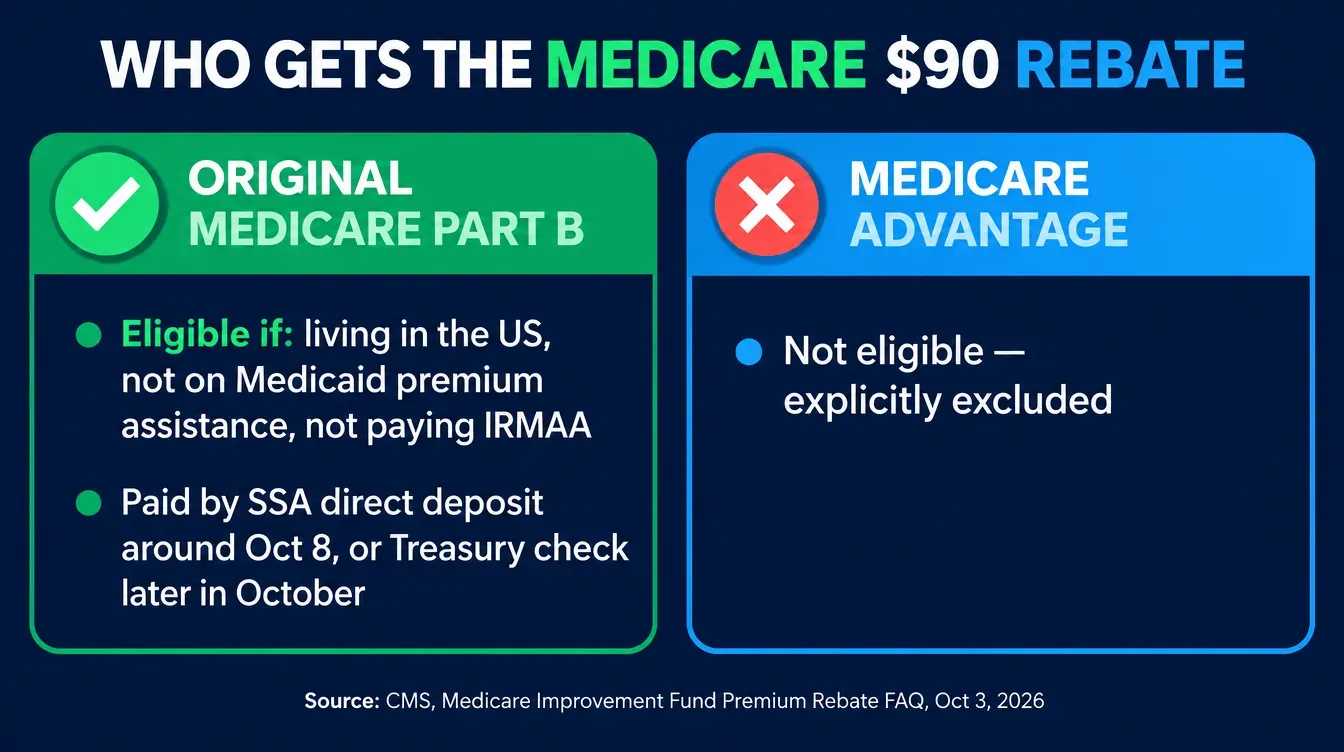
Original Medicare Part B just got a one-time $90 rebate this month, and Medicare Advantage didn’t — which is exactly backwards from what most of your clients assume when they see the news. CMS calls it the Medicare Improvement Fund Premium Rebate: a single $90 payment landing by direct deposit around October 8, 2026, or by paper check later in the month, for beneficiaries who meet three specific conditions (CMS, Medicare Improvement Fund Premium Rebate FAQ, Oct. 3, 2026). It lands five days before AEP opens, in the same week every scam operation that runs every October gets a brand-new hook to use, and it’s specific enough — a dollar figure, a date, a government name attached — that your clients are going to ask you about it whether or not you brought it up first. This article covers exactly what the rebate is, why the eligibility line splits your book in a way the news coverage usually doesn’t explain clearly, the manual script you can send before the phone rings, the scam pattern riding in behind it, and where Ambrose’s agent-vault and channel-bridge spokes fit if you’d rather not build the segmentation by hand every October.
Key takeaways
- CMS is issuing a one-time $90 rebate to "the 20.8 million Americans in Original Medicare Part B" who aren't on Medicaid premium assistance and don't pay an Income-Related Monthly Adjustment Amount — "Beneficiaries enrolled in Medicare Advantage are not eligible" (CMS, Medicare Improvement Fund Premium Rebate FAQ, Oct. 3, 2026).
- Most payments arrive by direct deposit "on or around October 8" via the Social Security Administration; a Social Security payment-status line opens October 15, 2026 — the same day AEP enrollment opens (CMS, same FAQ).
- Medicare fraud, errors, and abuse already cost taxpayers "about $60 billion every year," per the FTC — and a real, newsworthy, dollar-specific payment is exactly the kind of story scammers build a fake version of (FTC, May 28, 2026).
- AEP enrollment itself runs October 15 through December 7 under 42 CFR 422.62(a)(2)(iii); marketing for the upcoming plan year is separately permitted starting October 1 under 42 CFR 422.2263(a) — two different dates this story's timing sits right on top of.
- Ambrose's agent-vault spoke tags every client's line of business (MAPD, PDP, Med Supp, ACA, Group, ICHRA) automatically, which is the fastest way to find your Original Medicare segment before the calls start (Ambrose docs, spoke-agent-vault).
What the $90 rebate actually is
CMS’s own framing is that “the Administration is making a $90 Premium Rebate available for Part B premiums to certain Medicare beneficiaries… to put healthcare dollars back where they belong” (CMS, Medicare Improvement Fund Premium Rebate FAQ, Oct. 3, 2026). Strip the framing out and the mechanics are specific and checkable.
The money comes from the Medicare Improvement Fund, a fund created by Section 7002 of the Supplemental Appropriations Act of 2008 “to make improvements under the original fee-for-service program under parts A and B for individuals entitled to, or enrolled for, benefits under part A or enrolled under part B” (CMS, same FAQ). It’s a one-time payment, not a premium reduction baked into anyone’s monthly bill, and it isn’t deducted or applied automatically to a future premium the way a Part B giveback on a Medicare Advantage plan works — it’s a separate $90, delivered once, in October 2026.
| Condition | Original Medicare Part B | Medicare Advantage |
|---|---|---|
| Eligible for the $90 rebate | Yes, if the three criteria below are met | No — explicitly excluded |
| Lives in the United States | Required | Not applicable |
| Receives Medicaid premium assistance | Disqualifies if yes | Not applicable |
| Pays an Income-Related Monthly Adjustment Amount | Disqualifies if yes | Not applicable |
| How it arrives | Direct deposit from SSA (~Oct. 8) or Treasury paper check (later in October) | Not issued |
Three criteria, all stated directly in the FAQ: live in the United States, don’t receive premium assistance from Medicaid, and don’t pay an Income-Related Monthly Adjustment Amount, the surcharge higher-income beneficiaries pay on top of the standard Part B premium. Meet all three and you’re one of the “20.8 million Americans in Original Medicare Part B” CMS says the payment targets. Miss any one of them — you’re on Medicare Advantage, you’re dual-eligible with Medicaid covering your premium, or you’re paying IRMAA — and you’re not getting this specific $90, no matter what a client’s neighbor or a national news segment implied.
Delivery is just as specific. “The vast majority of eligible Medicare beneficiaries will receive the Medicare Improvement Fund Premium Rebate via direct deposit from the Social Security Administration,” with that direct deposit landing “on or around October 8th,” followed by “an email or a letter from the President in mid-October” (CMS, same FAQ). Beneficiaries without direct deposit on file get “a paper check for $90 from the U.S. Department of the Treasury later in October,” carrying the memo line “Medicare Improvement Fund Payment; $90 Payment to Offset October Premium” (CMS, same FAQ). None of it requires the beneficiary to do anything — no call, no form, no click. That single fact is the whole scam-defense in one sentence, and it’s worth building your client script around.
CMS also gives two specific numbers to verify this with, and they’re worth putting in front of every client who asks: call 1-800-MEDICARE (1-800-633-4227) to check eligibility, or call the Social Security Administration at 1-800-772-1213, starting October 15, 2026, to check payment status (CMS, same FAQ). Both are the beneficiary calling a known government number, not responding to an unsolicited call, text, or email.
Why your phone is already ringing about this
This story has every ingredient that makes a Medicare topic travel fast through a client base: a specific dollar amount, a specific date, the words “government payment,” and enough national coverage that a client doesn’t need to be looking for insurance news to run into it. None of that requires the client to understand the Medicare Advantage exclusion, and the coverage mostly doesn’t spell it out clearly either — “Medicare beneficiaries get $90” is the headline; “unless you’re on Medicare Advantage” is a sentence buried in paragraph six, if it’s there at all.
Layer the calendar on top and the timing gets worse before it gets better. The direct-deposit wave lands October 8. The Social Security payment-status line doesn’t even open until October 15 — the exact same day AEP enrollment opens under 42 CFR 422.62(a)(2)(iii) (Cornell Law, LII, current eCFR text). For one full week, between October 8 and October 15, your Medicare Advantage clients have had a full week to notice their Original Medicare neighbor got $90 and they didn’t, with no official phone line yet open to ask SSA about it directly — so they call you instead, right as you’re trying to run your own AEP calendar.
Marketing for 2027 plans is already allowed when this news breaks
MA organizations may begin marketing prospective plan year offerings on October 1 of each year for the following contract year (42 CFR 422.2263(a), U.S. Government Publishing Office, current CFR text). This news lands squarely inside that window — not before it, the way some other AEP-adjacent questions do. The compliance question here isn't "am I allowed to talk to clients right now," it's "does this specific message count as marketing material," which the FAQ section below addresses directly.
What it costs to get this wrong
There’s a real, sourced number behind why this matters beyond one irritated phone call. The FTC states plainly that “Medicare losses due to fraud, errors, and abuse cost taxpayers about $60 billion every year” (FTC, Medicare Fraud Affects Everyone, So Here’s What to Know and Do, May 28, 2026). That’s the backdrop a real, dollar-specific, date-specific government payment lands against — and it’s exactly the kind of story a scam operation can stand up a fake version of within days, because the real version already did the work of making $90 and October 8 sound legitimate.
The cost to you specifically isn’t abstract either. A client who gets a wrong answer from you — told they’re getting the $90 when they’re on Medicare Advantage and aren’t, or told to click a link that turns out to be the scam version because you didn’t warn them what the real process looks like — doesn’t file that under “my agent made an honest mistake about a one-time government program.” They file it under “my agent didn’t know what they were talking about,” right as you’re asking them to trust your judgment on next year’s plan. And if your outreach about this topic drifts from a factual client-service note into something that reads as plan-specific marketing without the disclaimer and handling CMS requires for that category of communication, you’ve created a second, entirely avoidable compliance question on top of the first one.
The manual method: two scripts, sent before the phone rings
None of what follows requires a membership or any piece of software. It requires knowing which of your clients are on Original Medicare before the first confused text arrives, and having two short, accurate messages ready instead of improvising an answer eleven times in a row.
Pull your Original Medicare segment first
Open your CRM or carrier portal and filter for clients who are not enrolled in a Medicare Advantage plan — Original Medicare with or without a Medigap policy, and separately, anyone on a stand-alone Part D plan. Those are your two populations with a real reason to ask about this.
Draft one factual message for that segment
"You may see a one-time $90 payment from Medicare this month — CMS calls it the Medicare Improvement Fund Premium Rebate. It's automatic if you qualify; you don't need to do anything to get it. Most people get it by direct deposit around October 8, or a paper check later in October. Call 1-800-MEDICARE if you want to confirm your own eligibility." Nothing about a plan, a premium comparison, or an offer — just the fact, with the number to verify it independently.
Draft a separate message for your Medicare Advantage clients
"If you've seen news about a $90 Medicare payment this month, it's specific to Original Medicare Part B and doesn't apply to Medicare Advantage plans, so you won't see this particular deposit. If anyone contacts you claiming you're owed it and asks for your Medicare number or bank details to release it, that's not how the real program works — don't give that information out." This one does double duty: it answers the question before it's asked and it inoculates against the scam version in the same breath.
Send both before October 8, not after
A proactive note that arrives before the deposit does reads as you being on top of things. The identical message, sent reactively after five people have already called confused, reads as you playing catch-up. Same content, different impression, purely a function of timing.
Keep it a service note, not a pitch
If you want to use this news to start a plan conversation with someone, that's a different message, and it needs the TPMO disclaimer and marketing-material handling CMS requires for anything that functions as marketing under 42 CFR 422.2263. Don't let the two blur together in the same text.
Log who you sent it to and when
A dated record of "sent the $90-rebate note to the Original Medicare segment on October X" is the whole audit trail you need if anyone ever asks what you told clients and when.
The hard part isn't writing the message — it's the segmentation
Most agents could write either script above in two minutes. What actually eats the time is pulling an accurate Original-Medicare-versus-Medicare-Advantage list out of a CRM that wasn't built to answer that specific question quickly, especially on a book with a few hundred clients and inconsistent tagging. That's the step worth automating once you've done it by hand at least once.
The scam layer: what the fake version of this looks like
The FTC’s own guidance is specific about the mechanism: “a scammer might ask you to confirm your Medicare number” under some pretext tied to a payment or benefit, information they then use “to commit hospice fraud” or other fraudulent billing (FTC, Medicare Impersonators). The real $90 rebate requires zero confirmation from the beneficiary — CMS’s FAQ never describes a step where someone has to verify their Medicare number to receive it. Anything that asks a client to confirm, verify, or “release” the payment by providing that number is, by construction, not the program CMS described.
The FTC’s open-enrollment-specific alert, published the same week as the premium announcement, adds the lookalike-website pattern: scammers “create web addresses that look similar to government website addresses” and misuse “keywords and official-looking logos” to impersonate Healthcare.gov or Medicare.gov, with victims risking “paying for a scammy plan that’s not health insurance, or exposing yourself to medical identity theft” (FTC, What to Know Ahead of Open Enrollment to Avoid Health Insurance Scams, Sep. 28, 2026). The same alert’s protective advice applies directly here: type a website address in rather than clicking a search result or a text link, confirm the domain actually ends in .gov, and watch for “small ‘Ad’ or ‘Sponsored’ labels” on anything that shows up in a search for Medicare or the rebate specifically (FTC, same alert).
| Signal | The real $90 rebate | A likely scam version |
|---|---|---|
| Action required from the beneficiary | None — it's automatic if eligible | Asks you to click, call, confirm, or "activate" |
| Contact method | You call a known number (1-800-MEDICARE, 1-800-772-1213) | They call, text, or email you first |
| Information requested | Nothing — payment uses info SSA already has on file | Asks for your Medicare number, SSN, or bank details |
| Web address | cms.gov, medicare.gov, ssa.gov | A lookalike domain, often found via a paid ad |
If a client tells you they already gave out information to something that matched the right-hand column, the FTC’s advice is to report it at ReportFraud.ftc.gov or to Medicare directly at 1-800-633-4227, and to flag any suspected medical identity theft to their provider or plan (FTC, Medicare Fraud Affects Everyone, May 28, 2026). That’s a referral you can make in one sentence, and it’s worth having ready alongside the two scripts above.
The October calendar this is landing on
Context matters here, because this isn’t the only Medicare news your clients are seeing this month. CMS’s premium announcement the week before the rebate FAQ gives useful backdrop for why “Medicare is making things more affordable” headlines are everywhere right now: the weighted average Medicare Advantage premium is projected to fall from $14.37 in 2026 to $12.00 in 2027, and the average stand-alone Part D premium is projected to rise less than a dollar, from $35.09 in 2026 to $36 in 2027 (CMS, Medicare Advantage and Medicare Prescription Drug Programs Expected to Remain Stable in 2027, Sep. 28, 2026).
Average monthly premiums: 2026 vs. 2027
Weighted average Medicare Advantage premium and average stand-alone Part D premium, per CMS's September 28, 2026 press release.
Source: CMS, "Medicare Advantage and Medicare Prescription Drug Programs Expected to Remain Stable in 2027" (Sep. 28, 2026).
Lay the full sequence out and the reason this question clusters so tightly into one week becomes obvious:
| Date | What happens |
|---|---|
| Sep. 28, 2026 | CMS announces 2027 MA and Part D premium projections |
| Oct. 1, 2026 | Marketing for 2027 plans may begin, under 42 CFR 422.2263(a) |
| Oct. 3, 2026 | CMS publishes the $90 rebate FAQ |
| ~Oct. 8, 2026 | Most direct-deposit rebate payments land |
| Mid-Oct. 2026 | Follow-up letter/email sent to recipients; paper checks continue going out |
| Oct. 15, 2026 | AEP enrollment opens (42 CFR 422.62); SSA payment-status line opens |
| Dec. 7, 2026 | AEP enrollment closes |
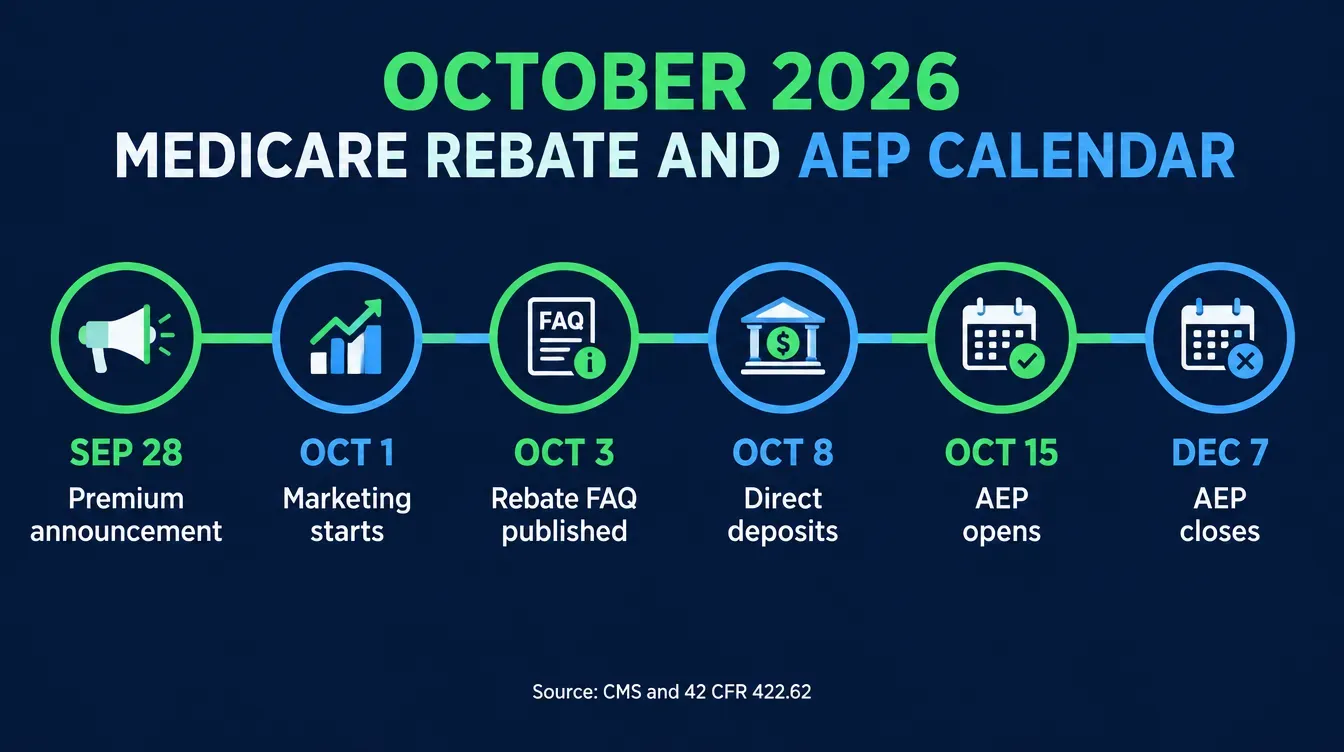
The rebate and AEP open enrollment share a calendar, not a program. Treating them as the same conversation is how an accurate client note turns into an inaccurate one.
Mike MooreWhere the manual version breaks down at scale
Writing the two scripts above takes ten minutes. Finding the right list to send them to is the part that doesn’t scale cleanly once a book gets past a few dozen clients with inconsistent plan-type tagging.
Filtering a CRM export by hand
- Depends on every client record being tagged consistently with plan type in the first place
- Easy to miss someone who switched from MA back to Original Medicare mid-year
- No automatic re-check before next year's version of this same news cycle
agent-vault's line-of-business classification
- vault_classify_lob automatically categorizes each client as MAPD, PDP, Med Supp, ACA, Group, or ICHRA (Ambrose docs, spoke-agent-vault)
- Runs against files that live in your own account, with PHI Rail routing, not raw records sent to an external model (Ambrose docs, spoke-agent-vault)
- A Routine can re-run the segmentation on a cron schedule and hand the result to channel-bridge, instead of someone remembering to re-pull the list
How Ambrose does this: agent-vault, channel-bridge, and a Routine
Here’s the part worth being precise about instead of oversold. Ambrose’s spoke catalog describes agent-vault as “the agency’s private book of business,” with four documented tools: vault_search, which runs full-text and structured searches across indexed files; vault_get_client, which retrieves a client record by ID with cross-CSV data joining; vault_list_recent, which surfaces recently changed or added files; and vault_classify_lob, which automatically categorizes each client’s line of business across six categories — MAPD, PDP, Med Supp, ACA, Group, and ICHRA (Ambrose docs, spoke-agent-vault, fetched October 2026). That classification is the mechanism this article has been describing by hand: a query for every client not tagged MAPD surfaces the Original Medicare Part B segment of a book without a manual CRM filter.
Files stay in the agency’s own account, and queries route through the PHI Rail, which means summarized, anonymized results reach the model rather than raw client records crossing an external network (Ambrose docs, spoke-agent-vault). That matters here specifically because the question “which of my clients are on Original Medicare” is a question about protected plan-enrollment data, not a generic analytics query — exactly the kind of thing that shouldn’t be typed into a general-purpose AI tool with no Business Associate Agreement behind it.
Once the segment exists, channel-bridge is the dispatcher. Its spoke documentation lists two tools, bridge_send_email and bridge_send_sms, covering outbound messages through providers like Gmail, GoHighLevel, or Twilio, and it defaults to a drafts mode: messages sit for review before anything actually sends, with auto-send only available per agent or team after a review period (Ambrose docs, spoke-channel-bridge, fetched October 2026). For a message this specific — a government payment, a dollar figure, a date — that review step is the right default, not a limitation. You’d want to read the draft before it goes to four hundred people regardless of what tool wrote it.
| Manual step | Ambrose equivalent |
|---|---|
| Filtering a CRM export for Original Medicare vs. Medicare Advantage clients | vault_classify_lob auto-tags every client by line of business (Ambrose docs, spoke-agent-vault) |
| Drafting two separate scripts and copy-pasting into a texting tool | bridge_send_email / bridge_send_sms hold drafts for review before sending (Ambrose docs, spoke-channel-bridge) |
| Remembering to run this again for next year's version of the same news cycle | A cron-scheduled Routine with an output sink to Slack or email (Ambrose docs, Routines) |
What’s not documented, and what this article isn’t claiming: nothing in Ambrose’s current spoke catalog tracks a specific client’s Medicaid premium-assistance status or IRMAA bracket, the two finer eligibility conditions CMS’s FAQ lists alongside the Medicare Advantage exclusion. agent-vault gets you to the right segment fast; it doesn’t replace actually knowing which of your Original Medicare clients also happen to be dual-eligible or paying IRMAA before you tell them anything definitive about their own eligibility.
This replaces the filtering and the sending, not your judgment
A segmented list and a reviewed draft still need a human reading them before they go out, especially on a topic this time-sensitive and this easy to get subtly wrong. AI-generated outputs, including anything Ambrose drafts, may contain errors — verify the current CMS figures and dates against the FAQ linked above before you send anything with this article's numbers in it.
Compliance notes before you send anything
The NAIC’s AI Model Bulletin, adopted December 2023, sets the governing standard for any AI tool touching a client-facing message like this: insurers and producers using AI are expected to ensure “decisions or actions made or supported by AI… comply with all applicable insurance laws and regulations,” with human professionals continuing to “play an important role in reviewing information, exercising judgment, and working directly with consumers,” and with insurers prepared to document their AI governance for a regulator on request (NAIC, Insurance Topics: Artificial Intelligence). A drafted message is an input to your own review, not a replacement for it.
Second, keep the factual, government-payment version of this message separate from anything that functions as plan marketing. 42 CFR 422.2263 governs marketing materials for Medicare Advantage and Part D communications, and a message that stays limited to “here’s a government payment you may be eligible for, here’s how to verify it yourself” is a different kind of communication than one that pivots into comparing this year’s plan to next year’s. If you’re unsure which category a specific message falls into, that’s a compliance-team or FMO question, not something to guess on with a topic this visible.
Tech Savvy Insurance is not a law firm, an insurance company, or an agency
Tech Savvy Insurance is a training and software community. It does not provide insurance, legal, tax, or compliance advice. You are responsible for your own licensure and for complying with all applicable CMS, HIPAA, state, and carrier rules. AI-generated outputs, including any Ambrose draft, may contain errors — always verify against the current CMS FAQ and your own compliance guidance before you send anything. Results may vary.
What you get by joining
One Ambrose seat, including agent-vault, channel-bridge, and Routines, comes with a Tech Savvy Insurance membership: $97 a month, billed monthly, cancel anytime, founding rate locked in while the membership stays continuously active (ambrose usage itself is billed separately from the $97 seat — see the full Spokes catalog for what else is included). Alongside the seat: weekly Zoom calls with open Q&A and build-with-you sessions, more than 30 hours of recorded training updated monthly, Meta Ads and AI marketing training built for health and life agents, pre-built AI templates and bot deployments, and a free annual in-person member workshop — in an explicit no-recruiting zone, so you can ask a real question about a client’s confused text without getting pitched a downline an hour later.
Everything above — the eligibility line, the exact dates, the scam pattern, the two scripts — works whether you ever join anything or not. Build the segmented list this week by hand and send both messages before October 8, or let a scheduled Routine flag the segment and draft them for you.
Send the $90-rebate note before the calls start
Direct deposits land around October 8, five days before AEP opens October 15. Pull your Original Medicare clients from whatever you already use to track plan type, send the factual version of this article's script, and keep the plan conversation separate. That's the whole manual system, no membership required. If you'd rather have the segmentation and the draft done for you, with people watching your screen while you set it up, one Ambrose seat comes with the Tech Savvy membership.
Join Tech Savvy — $97/monthRelated reading: our guide to the October 1 to October 15 marketing window for exactly what you can and can’t say before AEP opens, our breakdown of the 48-hour Scope of Appointment rule change, our walkthrough of re-shopping your Medicare book before AEP, and our guide to what not to paste into a general AI tool for the PHI side of using AI on client-specific data.
The close
CMS built a real, one-time $90 rebate, tied it to Original Medicare Part B specifically, excluded Medicare Advantage explicitly, and timed the whole thing to land five days before AEP opens — which means your phone was going to ring about this whether you planned for it or not. Twenty-point-eight million eligible beneficiaries, a direct-deposit date, a paper-check date, two phone numbers to verify it, and a scam pattern that’s already well understood by the FTC: that’s the entire mechanism, sourced, instead of a secondhand version of it. Segment your book, send the right message to the right half of it, and keep the government-payment note separate from any plan pitch. This is the kind of thing that comes up on a Tuesday call the week a client forwards you a text asking them to “confirm” their Medicare number: $97 a month, cancel anytime, and nobody will pitch you a downline: https://techsavvyinsurance.com/.
Before you rely on any date or figure in this article
Tech Savvy Insurance is a training and software community, not an insurance company, agency, or law firm, and does not provide insurance, legal, tax, or compliance advice. You are responsible for your own licensure and for complying with all applicable CMS, HIPAA, state, and carrier rules. AI-generated outputs may contain errors — always verify. Results may vary.
Frequently asked questions
Sources
- CMS — Medicare Improvement Fund Premium Rebate: Frequently Asked Questions (Oct. 3, 2026) — cms.gov
- CMS — Medicare Advantage and Medicare Prescription Drug Programs Expected to Remain Stable in 2027 (press release, Sep. 28, 2026) — cms.gov
- Cornell Law, Legal Information Institute — 42 CFR 422.62, current eCFR text (Annual Coordinated Election Period) — law.cornell.edu
- U.S. Government Publishing Office — 42 CFR 422.2263, General Marketing Requirements (CFR-2025-title42-vol3) — govinfo.gov
- FTC — What to Know Ahead of Open Enrollment to Avoid Health Insurance Scams (Sep. 28, 2026) — consumer.ftc.gov
- FTC — Medicare Impersonators — consumer.ftc.gov
- FTC — Medicare Fraud Affects Everyone, So Here's What to Know and Do (May 28, 2026) — consumer.ftc.gov
- NAIC — Insurance Topics: Artificial Intelligence (Model Bulletin, adopted Dec. 2023) — content.naic.org
- Ambrose docs — spoke-agent-vault — app.hiambrose.com
- Ambrose docs — spoke-channel-bridge — app.hiambrose.com
- Ambrose docs — Routines — app.hiambrose.com
- Ambrose docs — What is Ambrose — app.hiambrose.com
Ready to put this into practice?
Join a private community of Health & Life insurance professionals using AI, Meta Ads, and automation to grow — without draining their bank account.
Join Tech Savvy — $97/month