
The Medicare disaster SEP is a Special Election Period, under 42 CFR 422.62(b)(18) for Medicare Advantage and the parallel Part D rule at 42 CFR 423.38(c)(23), that lets a beneficiary in a federally, state-, or locally declared disaster or emergency area enroll in, disenroll from, or switch a plan after missing another valid election window because of the disaster (eCFR, 42 CFR 422.62, accessed September 28, 2026). It runs from the earliest of the declaration date or the incident start date, through the end of the incident period plus two additional full calendar months — and most agents, in Florida especially, have never actually calculated one by hand.
Key takeaways
- The disaster SEP is codified at 42 CFR 422.62(b)(18) for MA and 423.38(c)(23) for Part D — it isn't a CMS courtesy, it's a standing regulation (eCFR, accessed September 28, 2026).
- The window opens on the earliest of the declaration date or the incident start date, and closes two full calendar months after the incident period ends — or up to 14 months if no end date is ever specified.
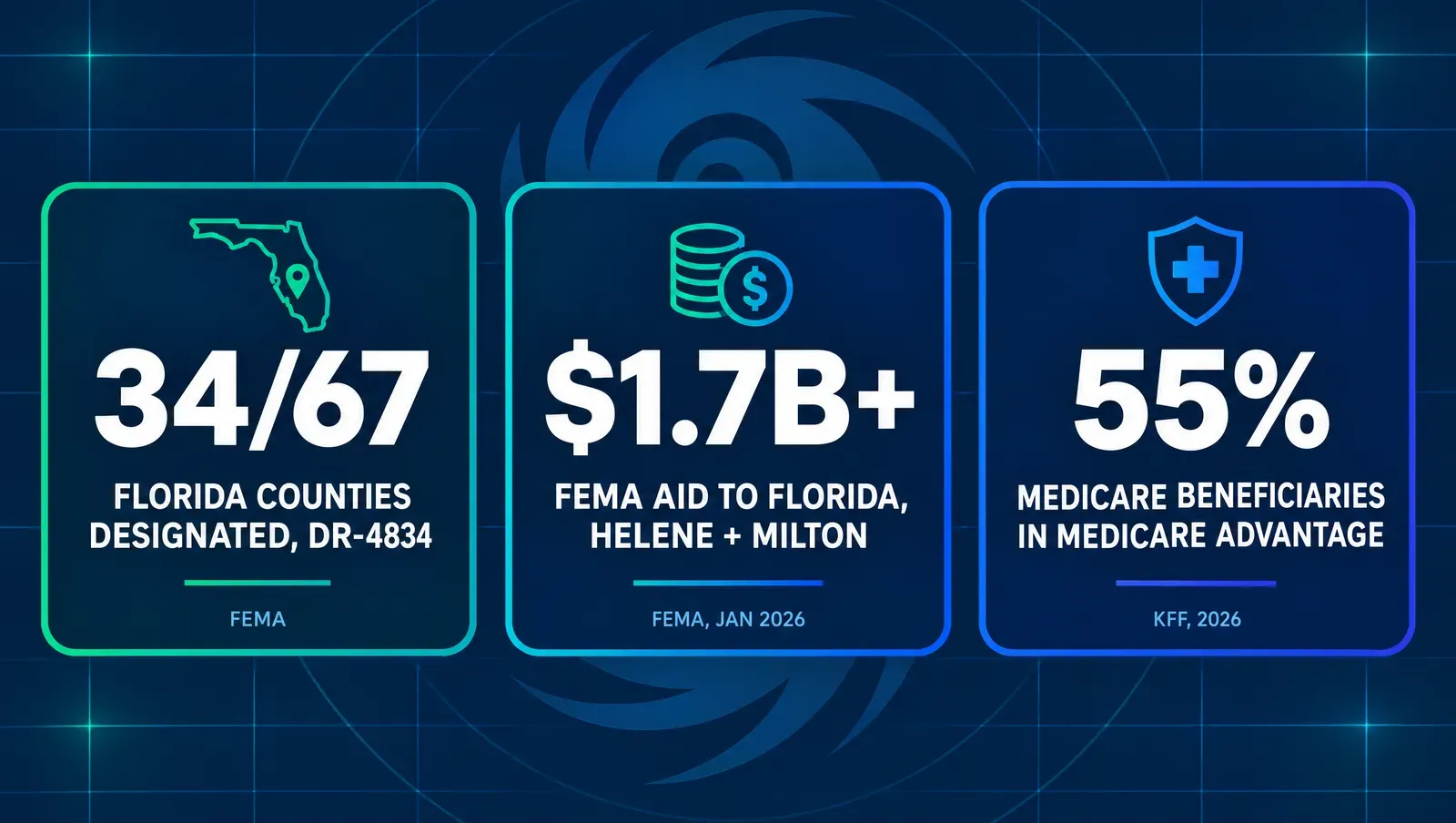
- Hurricane Milton's federal disaster declaration, DR-4834-FL, covered 34 of Florida's 67 counties in the exact weeks agents should be re-shopping ahead of AEP (FEMA, Disaster 4834 Designated Areas, accessed September 28, 2026).
- FEMA has delivered more than $1.7 billion in individual assistance to Florida survivors of Hurricanes Helene and Milton, a scale of disruption that outlasts any single agent's manual tracking (FEMA Fact Sheet 074, January 20, 2026).
- Ambrose's Brain is documented as fronting FEMA disaster declarations alongside CMS data, so a plain-English question can check a county's current status instead of a manual FEMA.gov lookup (Ambrose docs, fetched September 28, 2026).
What the Medicare disaster SEP actually is
Most agents know the name “disaster SEP” without knowing where it lives in the regulations or how CMS actually calculates it. It’s not a blanket extension of AEP, and it doesn’t apply to everyone in an affected state. It applies to a specific, narrower group: a beneficiary who lives (or, per the regulation, lived at the time) in an area under a government-declared emergency or major disaster, and who had another valid election opportunity — AEP, their Initial Enrollment Period, a different SEP — that they missed specifically because of that disaster.
The regulatory text is short and worth reading once in full, because most of what agents get wrong about this SEP comes from paraphrasing it instead of reading it: an individual may make an election if a federal, state, or local government entity has declared a disaster or other emergency, they were eligible for another election period at the time, and they didn’t make an election during that other period as a result of the disaster or emergency (eCFR, 42 CFR 422.62). Three conditions, all three required. A client who simply lives in a hurricane-affected county but wasn’t otherwise mid-election-window doesn’t automatically get a new one.
This article covers the rule and the manual lookup, not a marketing script
Everything below assumes you already run a compliant outreach process for SEP-based enrollments. If you need the fuller SEP landscape — Dual/LIS SEPs, other 2026 election periods — see our Medicare Special Election Periods guide. This piece is specifically about the disaster/emergency SEP: what triggers it, how long it runs, and how to check it for a specific county.
Why this collides directly with AEP prep in Florida
Here’s the part that makes this more than a trivia question for Florida agents specifically. The Annual Enrollment Period runs its standard October 15 through December 7 window every year (CMS, Medicare Open Enrollment, accessed September 28, 2026). Atlantic hurricane season runs June 1 through November 30 (NOAA/AOML Hurricane FAQ, accessed September 28, 2026), which means the exact weeks agents should be finishing book re-shops, confirming client contact information, and preparing AEP outreach are the same weeks a storm is most likely to make landfall in Florida. Nationally, 55% of Medicare beneficiaries with both Part A and Part B, 35.2 million of 64.2 million, were enrolled in a Medicare Advantage plan in 2026, according to KFF’s tracking of CMS enrollment data (data as of March 2026, updated July 1, 2026); Florida is one of the states where MA enrollment is deeply entrenched, and MA members are exactly the population whose plan networks and formularies can change year to year, making a missed AEP the costliest kind of missed window.
That’s the actual collision. A client who spends late September and early October without power, displaced from their home, or focused on storm recovery isn’t thinking about Part D formularies. If the storm knocks out their ability to act during AEP, or during whatever SEP they were otherwise eligible for, the disaster SEP is the mechanism that keeps them from being locked into a plan they never meant to keep for another full year.
Why agents miss it: the lookup isn’t obvious, and it isn’t in one place
The disaster SEP doesn’t fail because agents don’t care. It fails because checking it requires cross-referencing two systems that don’t talk to each other: FEMA’s declaration data, which is organized by disaster number and designated county, and CMS’s enrollment rules, which specify the eligibility test and the duration formula but don’t publish a live “is this county currently covered” answer anywhere a producer can just look up.
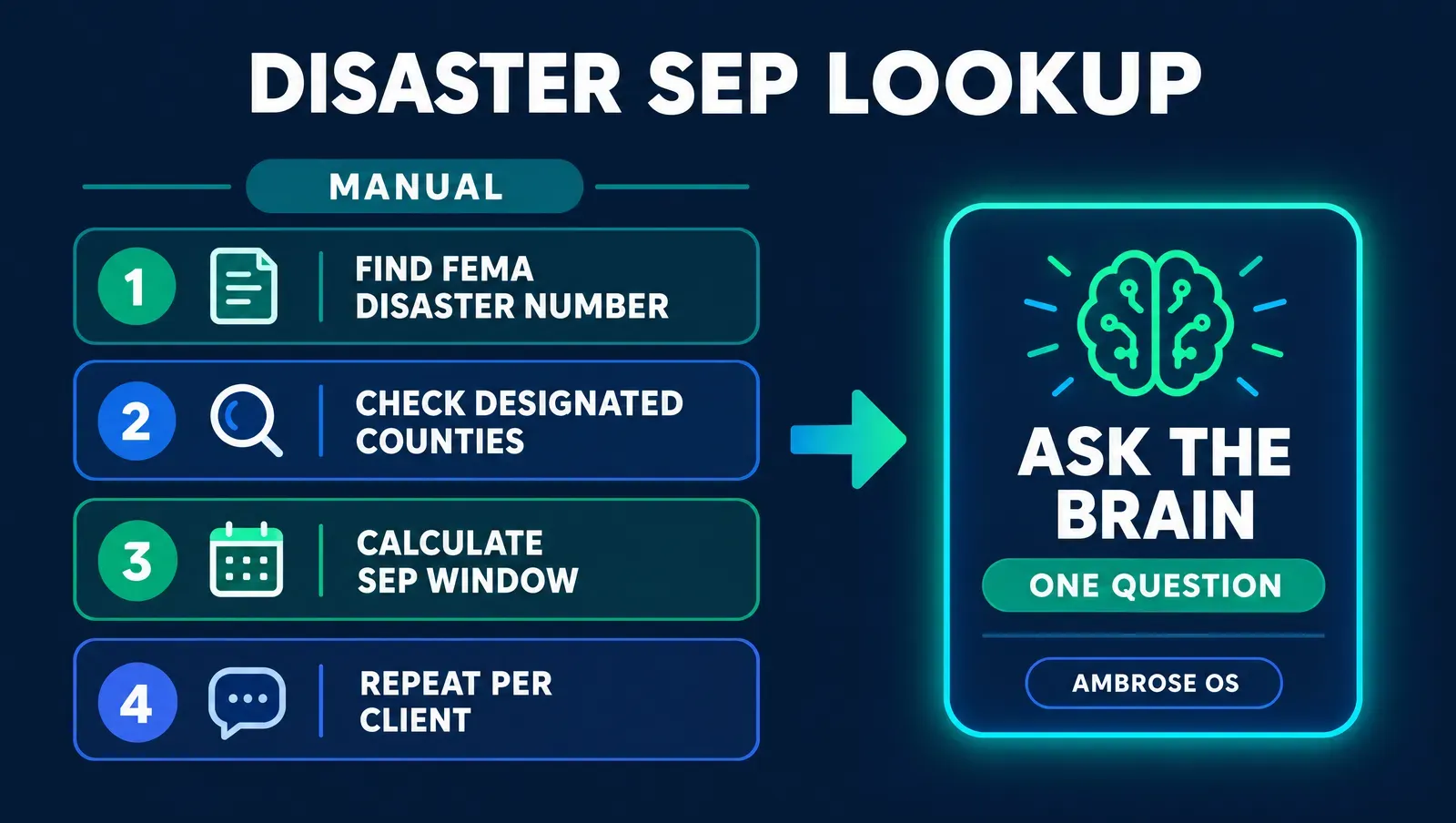
In practice, that means an agent who wants to know whether a specific client in a specific county currently qualifies has to: find the relevant FEMA disaster number, open that disaster’s designated-areas page, confirm the client’s county is listed, find the declaration and incident-period dates, and then run the CMS duration formula by hand to see whether the SEP window is still open. None of those steps is hard individually. Doing it for one client after a headline hurricane is manageable. Doing it as a standing practice, for a growing book, across a six-month hurricane season, every year, is the part that quietly doesn’t happen — which means the SEP exists on paper for a lot of clients who never hear about it.
What it costs when nobody checks
The scale here isn’t abstract. Hurricane Milton’s federal disaster declaration, DR-4834-FL, designated 34 of Florida’s 67 counties, plus the Miccosukee Tribe of Indians of Florida, for Individual Assistance and Public Assistance, declared October 11, 2024, with an incident period running October 5 through November 2, 2024 (FEMA, Disaster 4834; FEMA, Designated Areas, both accessed September 28, 2026). That’s more than half the state’s counties, under one storm, in one AEP-prep season. Combined with Hurricane Helene, which struck weeks earlier, FEMA had delivered more than $1.7 billion in individual assistance to Florida survivors by January 20, 2026 (FEMA, Florida Helene and Milton Recovery Fact Sheet 074). That figure alone should tell you how many households, in how many counties, were dealing with something more urgent than a plan comparison during the exact weeks AEP outreach normally happens.
The cost of missing this isn’t a fine or a chargeback. It’s a client who can’t act during AEP because of a storm, has no idea the disaster SEP exists, and ends up locked into a plan for a full additional year — potentially one whose network no longer includes a provider they need, or whose formulary changed against a drug they take. That’s the outcome this SEP exists to prevent, and it only prevents it if someone tells the client about it before the window closes.
A client who misses AEP because of a hurricane doesn't get a do-over unless somebody tells them the do-over exists. The regulation doesn't announce itself.
Mike MooreThe manual method: how to check disaster SEP eligibility by hand
This is the part we’re not holding back. Here’s the complete process, no tools beyond a browser and the client’s address.
Identify the client's county at the time of the disaster
The disaster SEP is tied to where the client lived when the disaster hit, not necessarily where they live today. Confirm the county from your CRM or the client directly.
Find the relevant FEMA disaster number
Search fema.gov/disasters, filtered to the state and incident type, or search the storm's name directly. Each declared event gets a disaster number (for example, DR-4834 for Hurricane Milton in Florida).
Check the designated-areas page for that disaster
Every FEMA disaster has a page at fema.gov/disaster/<number>/designated-areas listing exactly which counties are covered, and for what type of assistance. Confirm the client's county is on the list.
Pull the declaration date and incident period
The disaster's main FEMA page states the declaration date and the incident period (start and end dates, if an end date has been set). Both dates feed directly into the SEP calculation.
Calculate the SEP window
Start date: the earlier of the declaration date or the incident start date. End date: two full calendar months after the incident end date. No end date on file yet: the SEP is open, capped at 14 full calendar months from the start.
Confirm the client had a missed election window
Verify the client was actually eligible for another election period (AEP, IEP, another SEP) during the disaster window and document why the disaster prevented them from using it.
Do this for your book before hurricane season peaks, not after
The check above takes a few minutes per disaster, not per client — one FEMA lookup covers every client in the affected counties. The bottleneck is knowing which of your clients live in a newly declared area at all, which is the part that doesn't scale by hand across a full book and a six-month season.
A worked example: Hurricane Milton, DR-4834-FL
Numbers make this concrete faster than the rule text does. Here’s the actual calculation, using Milton’s confirmed dates.
| Input | Value |
|---|---|
| Declaration date | October 11, 2024 |
| Incident period start | October 5, 2024 |
| Incident period end | November 2, 2024 |
| SEP start (earlier of the two dates above) | October 5, 2024 |
| SEP end (2 full calendar months after incident end) | January 31, 2025 |
| Counties designated | 34 of 67, plus the Miccosukee Tribe of Indians of Florida |
Sources: FEMA, Disaster 4834; FEMA, Designated Areas; eCFR, 42 CFR 422.62(b)(18). This is an illustrative application of the published formula to a past, closed disaster, not a live eligibility determination — always confirm current SEP status through your carrier, 1-800-MEDICARE, or CMS guidance before enrolling a real client.
Hurricane Milton disaster SEP timeline
Incident period plus the two-month CMS extension, applied to DR-4834-FL.
Source: eCFR, 42 CFR 422.62(b)(18); FEMA, Disaster 4834. Bar widths are illustrative, not to a literal day scale.
Walk through the logic once and it stops being mysterious. The incident period ran through November 2. Because that’s partway through November, the “two full calendar months following” are December and January in full, which is why the window in this example runs through January 31 rather than closing at the end of December. Change the incident end date by even a few days and the answer shifts by a full month, which is exactly why this has to be calculated from the actual declaration, not remembered from a prior storm.
Common scenarios agents actually run into
The regulation reads clean on paper. Real books produce messier questions. Here’s how the rule applies to the cases that come up most.
| Scenario | How the rule applies |
|---|---|
| Client evacuated to another state during the incident period | Eligibility is tied to the client's residence in the declared area at the time, not where they physically are when you reach them. Confirm their address of record was in a designated county during the incident period. |
| Declaration has no incident end date on file yet | The SEP is open, capped at 14 full calendar months from the start date, including any extension of the declaration. Check FEMA's page periodically — an end date can be added after the fact, which shortens the window from what you might assume. |
| Client already used a different SEP earlier in the same year | The disaster SEP is a separate election type from a chronic-condition SEP, a dual-eligible SEP, or a moving SEP. Using one doesn't disqualify a client from a later disaster SEP if all three regulatory conditions are independently met — but document both elections clearly in the file. |
| Client is a seasonal "snowbird" with a Florida address on file but was out of state during the storm | The same residence test applies. If their address of record was in the designated county during the incident period, the disaster is presumed to have affected their ability to act there, regardless of where they physically weathered it. |
| County was added to the declaration weeks after the initial announcement | FEMA amends designated-areas lists as damage assessments continue. Re-check the designated-areas page rather than relying on the disaster's initial notice — a county added later still uses the same incident-period dates for the SEP calculation. |
What not to do
This SEP gets misused in two directions, and both create real problems. The first is treating every client in a hurricane-affected state as automatically eligible — they aren’t. The regulation requires the client to have had another valid election opportunity they missed because of the disaster, not simply residence in the area. The second is skipping it entirely out of caution, which leaves a genuinely eligible client stuck in a plan for a year longer than the law requires.
A disaster SEP doesn't waive the marketing rules
Reaching out about a disaster SEP is still a Medicare marketing communication. The standard CMS Medicare Communications and Marketing Guidelines and the TPMO disclaimer requirements under 42 CFR Part 422 Subpart V apply the same way they apply to any other outreach (eCFR, 42 CFR Part 422 Subpart V, accessed September 28, 2026). Tech Savvy Insurance is a training and software community, not a law firm, and this isn't legal or compliance advice — confirm your current CMS and carrier requirements before you place the call.
The NAIC’s AI Model Bulletin expectations apply here too, the same way they apply to any AI-assisted process touching an insurance decision: a written policy on how a tool is used, a human reviewing what it surfaces before anyone acts on it, and documentation if a regulator or carrier ever asks. If you use an AI tool to check a county’s disaster status, that check is an input to your judgment, not a replacement for confirming the primary FEMA and CMS sources yourself.
How Ambrose’s Brain checks this in one question
Ambrose OS, the platform included with a Tech Savvy membership, includes a data service called the Brain. According to Ambrose’s own documentation, fetched this session: “The Brain is the data layer under everything Ambrose does: 33 federal and health data sources and 205 live tools, including the CMS Medicare landscape, HealthCare.gov marketplace plans and rates, FDA and NADAC drug prices, the NPI provider registry, Census, the Federal Register, and FEMA disaster declarations” (Ambrose docs, What is Ambrose, fetched September 28, 2026). FEMA disaster data sitting in the same layer as CMS Medicare data is exactly what makes this specific lookup faster: instead of opening FEMA’s site, finding the disaster number, and then separately applying the CMS SEP formula, you ask a plain-English question — is a specific county currently under an active FEMA disaster declaration, and what does that mean for a client’s election options — and the answer comes back pointed at the underlying federal source, the same way you’d want to verify it yourself.
| Manual step | With the Brain |
|---|---|
| Search FEMA.gov for the disaster number | Ask the question directly; FEMA disaster declarations are one of the Brain's documented data sources |
| Open the designated-areas page and scan for the county | The answer is pointed at the underlying federal source you can verify in one click |
| Manually apply the CMS duration formula | Ask for the window directly, then confirm the math yourself against 42 CFR 422.62(b)(18) |
| Repeat per client, per county, all season | Ask once per county; the same answer covers every client living there |
Be precise about what this is and isn’t. The Brain is a research and retrieval layer over primary federal data — it’s not a compliance officer, and it doesn’t file the enrollment or decide eligibility for you. It answers the factual question (is this county currently declared, and what does the CMS formula say about the window) faster than a manual cross-reference does, which still leaves the marketing-rules and documentation steps covered earlier squarely in your hands.
Building this into a hurricane-season routine
The check above doesn’t need to happen only after a headline storm. Ambrose’s Routines feature runs a scheduled prompt against an agent or team on a cron schedule and can send the result to an output sink — Slack, email, a GoHighLevel note, or a log — when it completes (Ambrose docs, Routines, fetched September 28, 2026). Applied here, that means an agency could set a weekly routine, running through hurricane season from June to November, that asks the Brain whether any new FEMA disaster declarations have posted for the counties in its book, and posts the answer to Slack. It doesn’t replace the medicare-watchdog spoke’s job of scanning plan-year and network changes for your existing book, which Ambrose documents separately as scheduled MAPD, PDP, and Med Supp intelligence (Ambrose docs, Spokes) — it’s a narrower, complementary check specifically for whether a disaster has newly opened an SEP for clients in a given county.
Ambrose usage is separate from the $97 seat
One Ambrose seat comes with a Tech Savvy membership; usage inside Ambrose runs through its own credit ledger, so cost stays visible rather than showing up as a surprise. Behavior for an agent or a routine like the one above lives in editable markdown that hot-reloads, so adjusting which counties it checks or how often it runs doesn't require a developer or a deployment cycle ([Ambrose docs, What is Ambrose](https://app.hiambrose.com/docs/what-is-ambrose)).
This is the kind of build agents actually put together on a Tuesday call with Ambrose open on the screen, not something you’re expected to configure alone from documentation. Everything above works whether you ever set that routine up or not — the manual lookup is the same regulation either way.
What you get by joining
One Ambrose seat, including the Brain and Routines covered above, comes with a Tech Savvy Insurance membership: $97 a month, billed monthly, cancel anytime, founding rate locked in while the membership stays active. Alongside the seat: weekly Zoom calls with open Q&A and build-with-you sessions, 30+ hours of recorded training, Meta Ads and marketing training built for this industry, pre-built AI templates and bot deployments, and a free annual in-person member workshop. It’s also an explicit no-recruiting zone — you can ask a real compliance question without ending up on someone’s downline pitch list, which is a real point of difference from most agent Facebook groups. Results may vary; nothing here is a promise of production or income.
Your pre-AEP hurricane checklist
Whether you run this by hand this year or build the routine, anchor it to the same calendar every hurricane season creates:
- June, hurricane season opens: Confirm every active client’s county is current in your CRM. The disaster SEP check only works if you know where your clients actually live.
- After any named storm makes landfall near your book: Check fema.gov/disasters for a new declaration, confirm designated counties, and calculate the SEP window for anyone affected.
- October 1 – October 15, pre-AEP window: Cross-reference any open disaster SEPs against clients who haven’t yet been reached for AEP planning — they’re your highest-priority outreach.
- October 15 – December 7, AEP: Work disaster-affected clients first if their SEP window and AEP overlap; document which election type you’re using for each enrollment.
- Through January 31 of the following year, and later for storms with no end date yet: Some disaster SEPs stay open well past AEP’s close — don’t assume the window shuts on December 7 for everyone.
The close
Everything above, the regulation, the manual FEMA-and-CMS lookup, the worked calculation, works whether you ever join anything or not — that’s the point of writing it out in full. If you’d rather have that lookup run on a schedule instead of a memory, with Ambrose’s Brain answering the county question and a routine watching your book through hurricane season, the weekly build-with-you calls are where agents actually set that up, with people who’ve already done it: https://techsavvyinsurance.com/.
Before you contact anyone about a disaster SEP
Tech Savvy Insurance is a training and software community, not an insurance company, agency, or law firm, and does not provide insurance, legal, tax, or compliance advice. You are responsible for your own licensure and for complying with all applicable CMS, state, and carrier marketing and disclosure requirements. AI-generated outputs, including any Brain query result, may contain errors — always verify against the primary FEMA and CMS sources before acting on them. Results may vary.
Frequently asked questions
Sources
- eCFR (Cornell LII) — 42 CFR 422.62, Election of coverage under an MA plan — law.cornell.edu
- eCFR (Cornell LII) — 42 CFR Part 422 Subpart V, Medicare Advantage Communication Requirements — law.cornell.edu
- CMS — Medicare Open Enrollment (Partner Resources) — cms.gov
- FEMA — Disaster 4834 (Hurricane Milton, Florida) — fema.gov
- FEMA — Disaster 4834 Designated Areas — fema.gov
- FEMA — Florida Helene and Milton Recovery Fact Sheet 074 (Jan. 20, 2026) — fema.gov
- KFF — Medicare Advantage in 2026: Enrollment Update and Key Trends — kff.org
- Ambrose docs — What is Ambrose — app.hiambrose.com
- Ambrose docs — Routines — app.hiambrose.com
- Ambrose docs — Spokes — app.hiambrose.com
- NOAA/AOML — Hurricane FAQ (Atlantic hurricane season dates) — aoml.noaa.gov
Ready to put this into practice?
Join a private community of Health & Life insurance professionals using AI, Meta Ads, and automation to grow — without draining their bank account.
Join Tech Savvy — $97/month