
Your client calls, and she’s not happy. She enrolled in a Medicare Advantage plan back in March because Medicare.gov’s Plan Finder — for the first time this year — showed her cardiologist as in-network right on the plan comparison screen. She never called you about a problem, because there wasn’t one, as far as she could tell from the government’s own website. Six weeks ago she tried to book a follow-up. The front desk had never heard of the plan. Now she wants to know why you didn’t catch this, and the honest answer is that she didn’t enroll off anything you told her — she enrolled off a brand-new Medicare.gov feature that CMS itself admits can be wrong. What most agents don’t know is that CMS already built a fix for exactly this scenario: a temporary, 2026-only Special Election Period, with a hard three-month clock and one phone number, not a normal SEP process.
Key takeaways
- CMS created a brand-new, temporary SEP in 2026 — "NEW Special Election Period for Incorrect Provider Information in Medicare Plan Finder" (CMS Product No. 12231-P, March 2026) — for people who enrolled in an MA plan through Plan Finder and later found their doctor wasn't actually in-network.
- All four eligibility criteria must be met: enrolled in an MA plan through Plan Finder on Medicare.gov, plan effective date between January 1 and December 1, 2026, within the first three months of enrollment, and the preferred doctor wasn't actually in-network (CMS, same source).
- The SEP only works one way: the beneficiary calls 1-800-MEDICARE (1-800-633-4227; TTY 1-877-486-2048) and says they got incorrect provider network information from Plan Finder. Plans can't process it directly, and neither can you.
- This is new for 2026 — Plan Finder started showing provider directory data as part of MA plan comparison in 2025, with CMS's interim data supplied through a partnership with SunFire Matrix, Inc. for Contract Year 2026 (CMS, Technical Implementation Guide, November 7, 2025).
- It's separate from the CY2027 structural fix covered in our Medicare Advantage ghost networks article — that's about plans submitting better data going forward; this SEP is about beneficiaries already harmed by bad data in 2026.
- Ambrose's medicare-watchdog spoke scans a book for network-change signals on a schedule, which is how you'd find the at-risk clients before they find the problem at a doctor's office.
The call you’re starting to get this AEP
Here’s the mechanism, stated plainly: in 2025, CMS added a new feature to Medicare Plan Finder that shows provider directory information — which doctors are in a plan’s network — right on the Medicare Advantage plan comparison screen (CMS, NEW Special Election Period for Incorrect Provider Information in Medicare Plan Finder, March 2026). Before this, a consumer comparing plans on Medicare.gov saw premiums, star ratings, and drug costs, and had to go hunting separately to check whether a specific doctor took a specific plan. Now the directory data sits right next to the plan they’re comparing, which makes it feel authoritative — it’s the government’s own site, after all, built into the same tool that shows the plan’s premium and benefits.
CMS says, in its own words, exactly what you’d expect from a brand-new data feed: “Because this is a new feature, some provider directory information may be incorrect, especially in this first year” (CMS, same source). That’s not a hedge buried in fine print — it’s the first substantive sentence of the fact sheet CMS wrote about this SEP. The government is telling you, directly, that the tool it just shipped can be wrong, and that it already expected enough people to get burned by it that it built a remediation path before the first Annual Election Period under the new system even finished.
The version of this that lands on your desk doesn’t usually sound like a policy question. It sounds like a complaint. The client enrolled in good faith off a government tool, the tool was wrong, and the person who gets the angry call is the one whose name is on the enrollment — which is you, even when you had nothing to do with the mistake. That’s the pain this article is about, and the SEP below is the fix CMS already built for it.
Why Plan Finder started showing network data in the first place
This didn’t happen in isolation — it’s the direct result of a regulatory push that’s been building for a while. On September 19, 2025, CMS finalized a rule establishing new requirements at 42 CFR 422.111(m): every Medicare Advantage organization has to make its provider directory data available to CMS for publication, submit it in a CMS-specified format and timeframe, update it within 30 days of a known change, and attest at least annually that the data is accurate (Federal Register, CMS-4208-F2, September 19, 2025). The rule took effect November 17, 2025, and became applicable January 1, 2026.
CMS is rolling this out in three phases, and the phase that matters for this article is already live. Phase One, for Contract Year 2026, is an interim solution: CMS partnered with SunFire Matrix, Inc. to supply in-network provider and facility data for most individual MA plan types (CMS, Technical Implementation Guide for Supplying MA Provider Directory Data for Use in MPF, November 7, 2025). That’s the data feeding the Plan Finder screens your clients are looking at right now, this AEP. Phase Two, the more structural fix where MA organizations submit their own standardized data directly, doesn’t start until Contract Year 2027 — we cover that rollout, the CEO/CFO/COO attestation requirement, and the full timeline in our ghost networks article, so I won’t re-derive it here. The short version for this piece: what’s live right now is an interim data source, built fast, and CMS is honest that it’s shakier than what’s coming in 2027.
| Phase | Status | What it is |
|---|---|---|
| Phase One | Live now, CY2026 | Interim data via CMS's partnership with SunFire Matrix, Inc. — this is what's showing on Plan Finder this AEP |
| Phase Two | Starts CY2027 | MA plans submit standardized JSON or FHIR directory data directly to CMS, with annual officer attestation |
| Phase Three | In development | A National Provider Directory intended to eventually consume every MA plan's feed directly |
How often directories are actually wrong, briefly
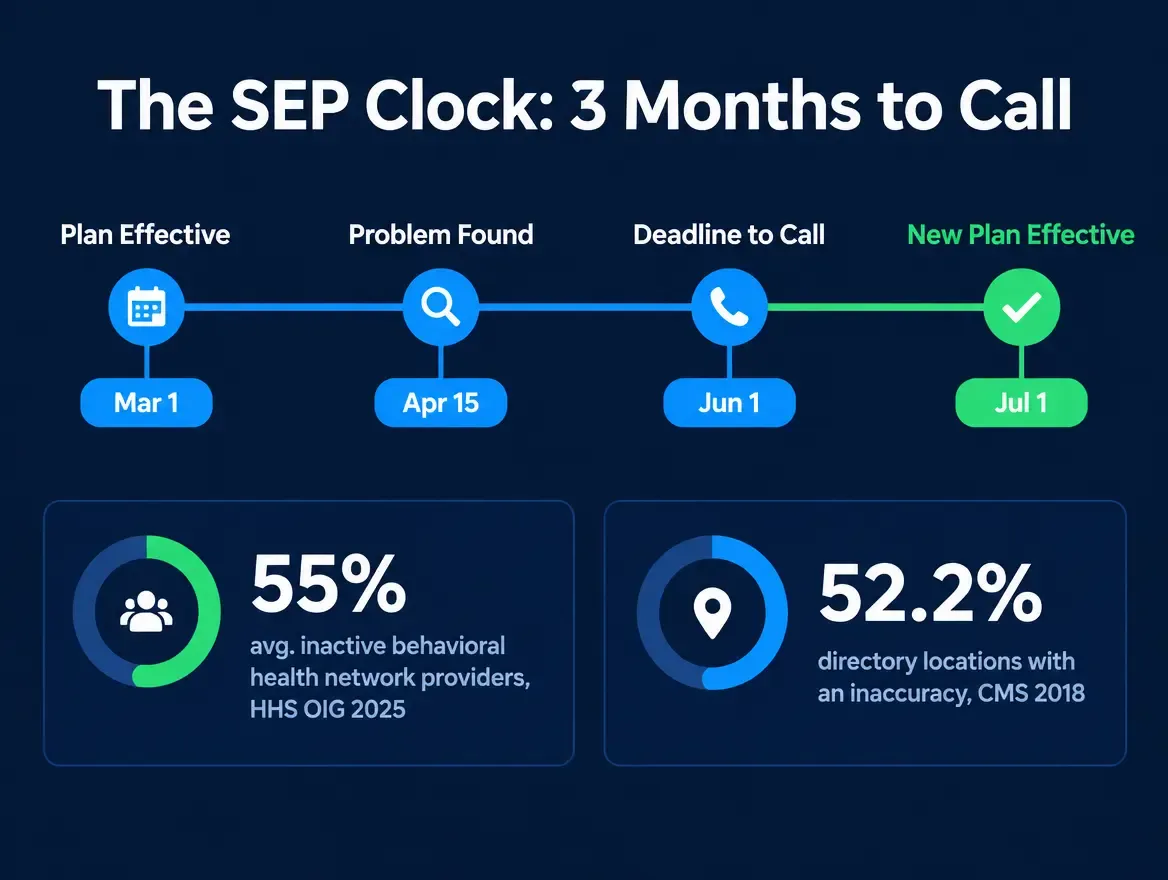
We’ve gone deep on this data already in the ghost networks article, so I’ll keep this short and point you there for the full breakdown. HHS’s Office of Inspector General found that, on average, 55% of the behavioral health providers listed in Medicare Advantage networks had zero encounters with any of that plan’s members in 2023, and 72% of those inactive listings should never have been in the directory at all (HHS OIG, OEI-02-23-00540, October 2025). CMS’s own older review, covering cardiology, oncology, ophthalmology, and primary care across 64 Medicare Advantage organizations in 2016-2017, found 52.20% of reviewed directory locations had at least one inaccuracy (CMS, Online Provider Directory Review Report, 2018). This isn’t a one-specialty problem, and it isn’t new — it’s why CMS built a Plan Finder feature at all, and it’s why that feature is already generating enough bad enrollments that CMS built a separate SEP to clean up after it.
The directory is new, the complaint is familiar, and the SEP exists because CMS already knew this would happen. The client didn't do anything wrong by trusting Medicare.gov. Neither did you.
Mike MooreScale matters here too. CMS projects that about 34 million people — 47.4% of all Medicare beneficiaries — will be enrolled in a Medicare Advantage plan for 2027, and the current 2026 Annual Election Period runs October 15 through December 7, 2026 (CMS, Medicare Advantage and Medicare Prescription Drug Programs Expected to Remain Stable in 2027, press release, September 28, 2026). Close to half of everyone on Medicare is choosing between MA plans using a Plan Finder screen that, by CMS’s own admission, may show incorrect provider information in its first year. That’s the population this SEP was built to protect.
The new 2026 SEP, explained in full
Here’s the whole thing, verbatim where it matters, because precision is the entire point of a compliance-adjacent article like this one. CMS’s fact sheet is titled “NEW Special Election Period for Incorrect Provider Information in Medicare Plan Finder,” carries CMS Product No. 12231-P, and is dated March 2026 (CMS, same source). The opening framing is direct: “To protect people who rely on Plan Finder information to inform decisions, a new temporary Special Election Period (SEP) is available in 2026 to make sure people can change their MA Plan if they enrolled based on inaccurate provider information in Plan Finder.” And it’s explicit about its own shelf life: “The SEP is available through 2026 only by calling 1-800 MEDICARE (1-800-633-4227). TTY users can call 1-877-486-2048.”
Eligibility requires all four of the following, with no partial credit:
| Criterion | What it means in practice |
|---|---|
| Enrolled through Plan Finder | The MA enrollment happened on Medicare.gov's Plan Finder — not a plan's own website, not a paper application, not an agent's own enrollment platform |
| Effective date Jan 1 - Dec 1, 2026 | The plan's effective date falls inside this specific 2026 window; enrollments outside it don't qualify for this particular SEP |
| Within first 3 months of enrollment | The call to 1-800-MEDICARE has to happen within three months of that effective date — there's no stated grace period |
| Preferred doctor not actually in-network | The beneficiary discovered, after enrolling, that a doctor they wanted to keep seeing isn't really part of the plan's network |
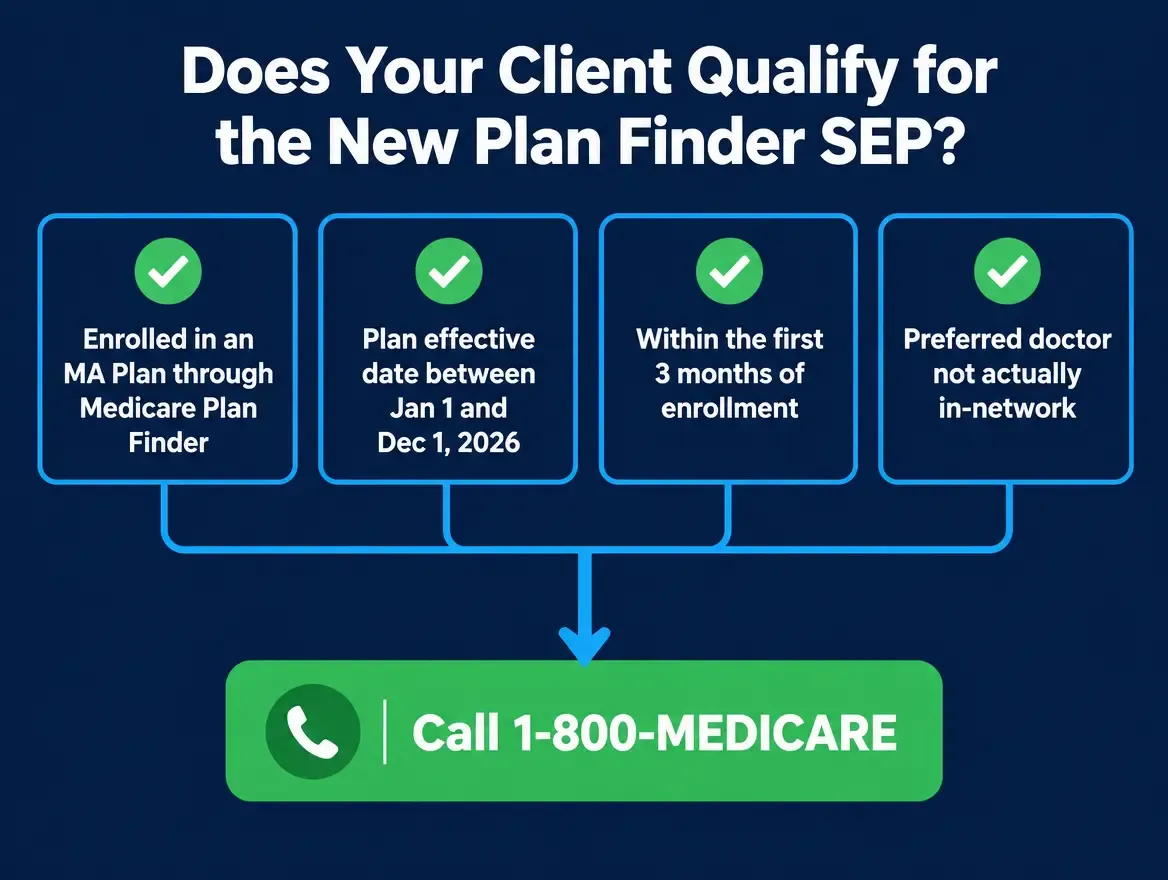
If a client meets all four, here’s what the SEP actually lets them do, per CMS: enroll in a new MA plan with or without drug coverage, disenroll from their MA plan and return to Original Medicare, or enroll in a standalone Part D plan and return to Original Medicare with Part D coverage. The new plan becomes effective the first day of the month after the application date — so a call made in May produces a plan effective June 1, not an immediate switch.
Two limits that catch agents off guard
First: "This SEP is only open to people who relied on incorrect information from Plan Finder (not from a plan website)" (CMS, same source). A client who checked the carrier's own site, not Plan Finder, doesn't qualify through this specific SEP even if the information was equally wrong. Second: "Plans can't accept enrollments/disenrollments directly from consumers using this SEP — people must call 1-800 MEDICARE." You cannot process this one through the carrier's normal enrollment channel, and neither can the client walk it in through a plan's member services line. It's beneficiary-initiated, through CMS directly, full stop.
Be precise with clients about what your role actually is here, because overstating it is both dishonest and a setup for a worse complaint later. You can recognize the situation, confirm the four criteria against the client’s actual timeline, and walk them through exactly what to say on the call. You cannot file this SEP, submit it, or process it on the client’s behalf — CMS built this one to go straight from the beneficiary to call-center staff, who will confirm the enrollment was done through Plan Finder and then help with new plan choices.
The complete manual method: what to actually do, free, right now
None of this requires a membership, a tool, or anything beyond a phone and five minutes of prep with the client. Here’s the whole thing.
Confirm the enrollment channel
Ask directly: did you enroll through Medicare.gov's Plan Finder, or somewhere else — a carrier's site, a paper form, an agent's platform? If the answer isn't "Plan Finder," stop here; this specific SEP doesn't apply, though other options might.
Check the effective date and the clock
Pull the plan's effective date. It has to fall between January 1 and December 1, 2026, and today's date has to fall within three months after that effective date. Do the math out loud with the client so there's no ambiguity about the deadline.
Confirm the provider problem is real
Have the client (or you, on their behalf, as their agent — not as part of this SEP's process) call the doctor's office and confirm, plainly, that the office doesn't participate in this specific plan. Write down the date and who you spoke to.
Walk the client through the call script
The client calls 1-800-MEDICARE (1-800-633-4227; TTY 1-877-486-2048) and says, in their own words, that they enrolled in their Medicare Advantage plan through Plan Finder on Medicare.gov, and they found their preferred doctor wasn't actually in the plan's network. That's the trigger phrase CMS's own fact sheet describes — nothing more elaborate is needed.
Know what call-center staff will do next
CMS's staff will confirm the enrollment was done through Plan Finder and help the person with new plan enrollment choices — a new MA plan, a return to Original Medicare, or a Part D-plus-Original-Medicare combination. The new coverage starts the first of the month after the application date.
Document everything on your side
Log the date you identified the issue, the date the client called, and the outcome. If this traces back to a complaint about your original recommendation, a clear record that the enrollment happened through Plan Finder — not through you — is exactly what protects you.
Worked example
A client's MA plan has an effective date of March 1, 2026. In mid-April, she tries to schedule with her cardiologist and learns the office has never been part of that plan's network. She's still well within the window — the deadline to call 1-800-MEDICARE is June 1, three months after her March 1 effective date. She calls on May 20, well before the deadline. Her new plan, selected on that call, becomes effective July 1 — the first of the month after her application date.
If the three-month window has already passed
Say so plainly to the client, because false hope here is worse than a disappointing but honest answer: this specific SEP is gone for that enrollment once the three-month mark passes. CMS’s eligibility list doesn’t carry a stated exception, extension, or appeal process for a late discovery. If your client found the problem in month four or later, this exact mechanism isn’t available to them, no matter how clearly the underlying facts favor them.
That doesn’t mean they’re stuck for the rest of the plan year. Two real paths remain. First, the 2026 Annual Election Period runs October 15 through December 7, 2026, and any MA member can use it to switch plans for a January 1, 2027 effective date, for any reason at all — no SEP needed (CMS, same press release cited above for the 2027 enrollment stat). Second, check whether a different SEP genuinely applies to the client’s actual situation — a permanent move, loss of other coverage, a qualifying life event — rather than stretching this Plan Finder-specific SEP to fit. Our Medicare Special Election Periods guide covers the full list CMS recognizes, and misusing a SEP that doesn’t actually fit creates its own compliance problem.
When this SEP doesn’t apply: your own funnel, not Plan Finder
No, and it’s worth being direct with yourself about why, because it’s an easy thing to want to apply more broadly than CMS built it. The first eligibility criterion isn’t “enrolled based on incorrect provider information somewhere” — it’s specifically “enrolled in an MA Plan through Plan Finder on Medicare.gov.” CMS’s fact sheet underlines this with its own limiting language: “This SEP is only open to people who relied on incorrect information from Plan Finder (not from a plan website).”
If your client enrolled through your own GoHighLevel funnel, a carrier’s direct enrollment page, a paper application you helped them complete, or a phone enrollment with you reading from a quoting tool, none of that is Plan Finder, and this government-built SEP doesn’t cover it — even when the underlying harm is identical: a doctor the client thought was in-network, isn’t. That gap matters, because it means the fix here is narrower than the problem. If your own enrollment process surfaced bad network data — say, from a quoting tool that pulled a stale directory — that’s a different conversation entirely: a service and documentation issue on your end, not a CMS SEP you can point the client toward. The manual verification method in our ghost networks article — the three-question call to the provider’s office, done before you submit an enrollment — is exactly the step that prevents your own funnel from ever putting a client in this position in the first place.
The compliance boundary: TPMO rules and what you can actually say
This SEP sits right at the edge of normal Medicare marketing communication, so it’s worth naming the boundary explicitly rather than assuming it away. A factual conversation with an existing client about a problem they’ve already reported — their doctor isn’t actually in-network, here’s the government SEP that might apply, here’s the number to call — is service to an existing enrollee, not a new marketing pitch, and doesn’t carry the same disclosure weight as prospecting content. If you’re a Third-Party Marketing Organization, your standard TPMO disclaimer and CMS’s general marketing-rule obligations still govern everything else you say and publish to Medicare beneficiaries, separately from this specific conversation — we cover those obligations in depth in our pre-AEP marketing rules guide.
Where it gets closer to a real line: if you’re on a recorded, agent-assisted enrollment call and the subject of provider network accuracy comes up, CMS’s standard scope-of-appointment and permission-to-contact requirements for that call type still apply in full — this SEP conversation doesn’t exempt you from anything you’d otherwise be required to do or disclose on that same call. And again, the thing you cannot do, no matter how helpful it feels: process this SEP for the client. CMS built it to be initiated by the beneficiary, directly, on a call to 1-800-MEDICARE — not routed through you, your agency, or the carrier.
Finding at-risk clients before they call you upset
Everything above is reactive — it’s what to do once a client has already found the problem. The better version of this job is catching it first, and that’s where Ambrose’s medicare-watchdog spoke actually fits, named specifically rather than waved at generally.
medicare-watchdog is documented as running “scheduled MAPD / PDP / Med Supp intelligence, cost hikes, plan discontinuations, network changes, Star Ratings, rate filings,” operating on federal data only — no client identifiers cross the wire (Ambrose docs, spoke-medicare-watchdog, fetched October 2026). It has four tools: medicare_scan_book scans the book for risk signals, medicare_check_plan pulls status and costs for a specific plan, medicare_star_diff compares Star Rating year over year, and medicare_rate_filing pulls the latest rate filing. Pointing medicare_scan_book at your book of MA clients enrolled this AEP, and watching for a network-change signal, is a direct, documented way to surface exactly the kind of client this article is about — before they’re the one calling you upset.
I want to be precise about what’s documented and what isn’t, the same way we were in the ghost networks article about marketplace-finder and plan-quoter. The medicare-watchdog docs describe a network-change signal on a scheduled scan. They don’t describe the spoke as detecting “SEP eligibility” specifically, or as cross-referencing a client’s doctor against this exact Plan Finder data to confirm the four criteria above — that judgment is still yours to make, the same way the manual method walks through it. What the scan gets you is the lead: which clients in your book had a network-change flag this plan year, so you’re the one calling them, not the other way around.
There’s a second honest tie-in worth naming. The Brain — Ambrose’s data layer — is documented as covering 33 federal and health data sources and 205 live tools, including the NPI provider registry (Ambrose docs, What is Ambrose, fetched October 2026; these counts move, and were confirmed current as of this fetch). That NPI registry is the same federal NPPES database the ghost networks article covers as a free, manual lookup at npiregistry.cms.hhs.gov. The honest version of this tie-in is simple: the Brain fronts the same federal NPI data as a queryable source inside Ambrose, rather than a separate manual lookup you run yourself — it doesn’t mean Ambrose independently verifies whether a specific doctor sees patients on a specific plan. No tool does that yet, including CMS’s own new system, which is precisely why the SEP and the phone call above still exist.
Keep client-specific notes out of general AI tools
If you're logging which clients had a network-change flag, which doctor was involved, and what the client said on the call, that's real PHI-adjacent information tied to a specific person's coverage. A general-purpose AI tool with no Business Associate Agreement with your agency isn't where that belongs. Ambrose's PHI Rail is documented as aliasing identifiers before any non-BAA destination sees them (Ambrose docs, What is Ambrose) — built for exactly this kind of note. With any tool outside a BAA, keep it generic, or keep it on paper.
What you get by joining
One Ambrose seat — including medicare-watchdog’s book-scanning tools — comes with a Tech Savvy Insurance membership: $97 a month, billed monthly, cancel anytime, founding rate locked in while the membership stays active. Alongside the seat: weekly Zoom calls with open Q&A and build-with-you sessions, 30+ hours of recorded training updated monthly, Meta Ads and AI training built for this industry specifically, pre-built AI templates and bot deployments, and a free annual in-person member workshop — with an explicit no-recruiting rule, so a real question about a client’s plan network doesn’t turn into a downline pitch.
The manual method above works whether you join or not
The eligibility checklist, the exact call script, the documentation habit — every step in this article is something you or your client can do for free, today, with a phone and the information above. Ambrose makes finding the at-risk clients in your book faster and more proactive; it doesn't replace the client's own call to 1-800-MEDICARE, and nothing else on the market replaces it either.
The close
This SEP exists because CMS shipped a new feature fast, admitted it could be wrong in its first year, and built a narrow, time-limited fix for the people it hurts. Your job isn’t to file it — you can’t — it’s to recognize it, confirm the four criteria, and make sure the client knows exactly what to say when they call. If you’d rather be the one finding these clients before they’re upset instead of after, that’s what medicare-watchdog’s book scan is for, and one Ambrose seat comes with a Tech Savvy membership. The weekly build-with-you calls are where agents actually get it set up: https://techsavvyinsurance.com/.
Compliance note
This article covers a federal enrollment remediation process and client communication about it, not marketing copy — but if you’re a Third-Party Marketing Organization under 42 CFR 422.2260, your standard TPMO disclaimer and CMS marketing-rule obligations still apply to everything else you publish and say to Medicare beneficiaries, separate from anything discussed here. If you use an AI tool to help draft client notes, complaint logs, or any Medicare-related communication, the NAIC’s Model Bulletin on the Use of Artificial Intelligence Systems by Insurers expects written policies, human oversight, and documentation, and states that “decisions or actions made or supported by AI must comply with all applicable insurance laws and regulations” (NAIC, Insurance Topics: Artificial Intelligence). Ambrose is HIPAA-aware by default, not HIPAA certified — no software platform can be “HIPAA certified,” and any vendor claiming otherwise is worth a second look. Results may vary.
Before you rely on any figure in this article
Tech Savvy Insurance is a training and software community, not an insurance company, agency, or law firm, and does not provide insurance, legal, tax, or compliance advice. You are responsible for your own licensure and for complying with all applicable CMS, HIPAA, state, and carrier regulations. Regulations and enforcement priorities can change — confirm current requirements directly with CMS, your carrier's marketing compliance team, or qualified legal counsel before relying on any figure here. AI-generated outputs may contain errors — always verify. Results may vary.
Frequently asked questions
Sources
- CMS — NEW Special Election Period for Incorrect Provider Information in Medicare Plan Finder (CMS Product No. 12231-P, March 2026) — cms.gov
- Federal Register — Medicare and Medicaid Programs; CY 2026 Policy and Technical Changes... Finalization of Format Provider Directories for Medicare Plan Finder Second Final Rule (CMS-4208-F2), September 19, 2025 — public-inspection.federalregister.gov
- CMS — Technical Implementation Guide for Supplying MA Provider Directory Data for Use in MPF (memo to MA Organizations, November 7, 2025) — cms.gov
- HHS Office of Inspector General — Many Medicare Advantage and Medicaid Managed Care Plans Have Limited Behavioral Health Provider Networks and Inactive Providers (OEI-02-23-00540), October 2025 — oig.hhs.gov
- CMS — Online Provider Directory Review Report, Round 2 (2016-2017 data, published 2018) — cms.gov
- CMS — Medicare Advantage and Medicare Prescription Drug Programs Expected to Remain Stable in 2027 (press release, September 28, 2026) — cms.gov
- NAIC — Insurance Topics: Artificial Intelligence (Model Bulletin) — content.naic.org
- Ambrose docs — spoke-medicare-watchdog — app.hiambrose.com
- Ambrose docs — What is Ambrose — app.hiambrose.com
Ready to put this into practice?
Join a private community of Health & Life insurance professionals using AI, Meta Ads, and automation to grow — without draining their bank account.
Join Tech Savvy — $97/month