
An AI executive team for an insurance agency, in Ambrose’s implementation, is the War Room: a fixed roster of nine AI department heads, Chief of Staff, CMO, CRO, COO, CCO, Compliance, Research, CFO, and CTO, that read your agency’s actual GoHighLevel and vault data and answer a plain-English business question by routing it to whichever head (or heads) actually owns that question, then synthesizing one answer (Ambrose docs, War Room). It exists because most independent agencies never had the headcount to have a real CFO or COO in the first place, and the owner has been doing all nine jobs alone since day one. This guide covers the actual pain of running an agency as a department of one, the free manual version of the same discipline you can start this week, and exactly how Ambrose’s War Room, included with a Tech Savvy Insurance membership, does the automated version.
Key takeaways
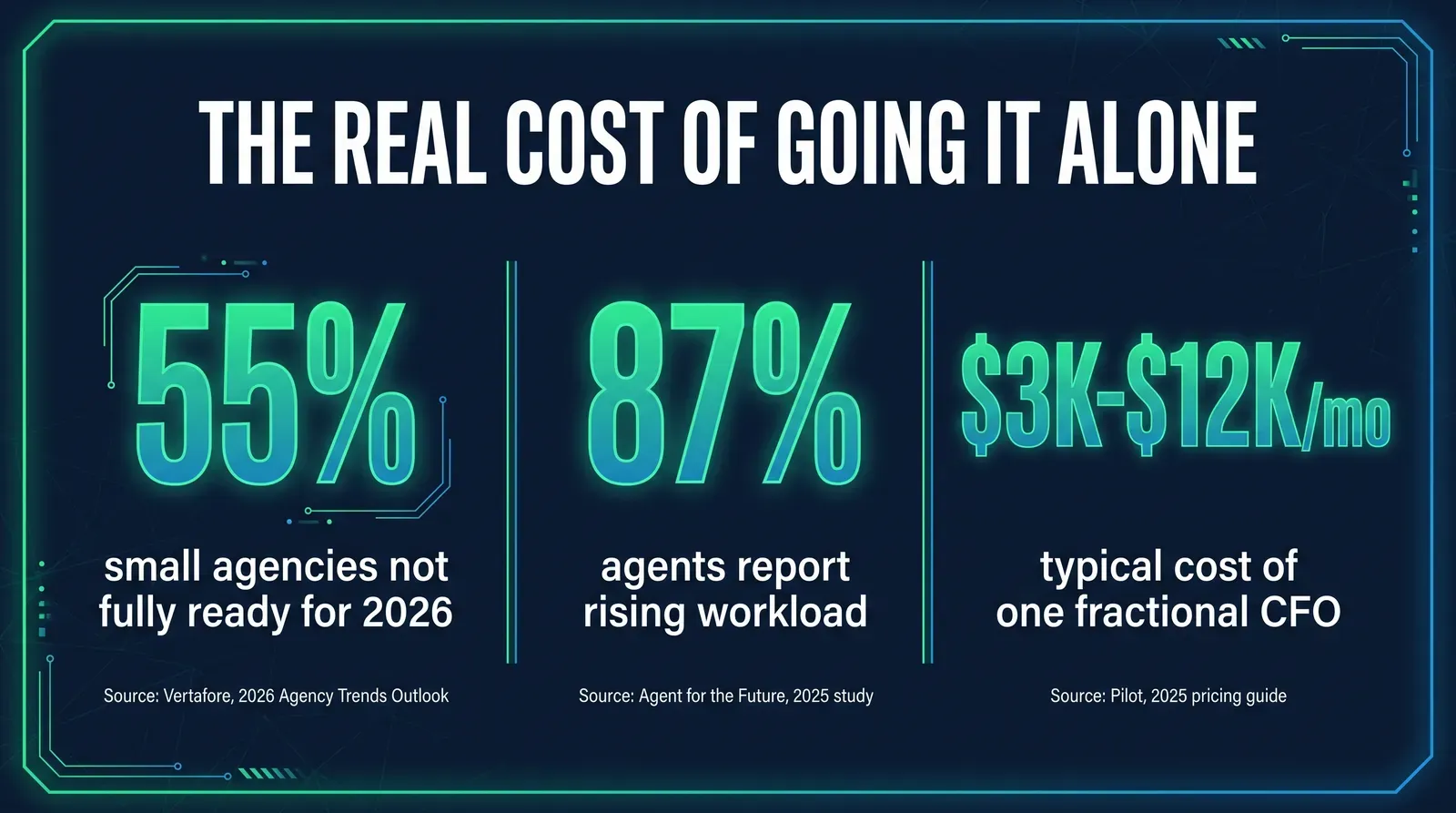
- More than half (55%) of independent agency professionals at agencies with six or fewer staff say they're only "somewhat prepared" or "not prepared" to keep pace with 2026's technology and market changes, per Vertafore's 2026 Insurance Agency Trends Outlook, a survey of over 1,300 independent agency professionals.
- 87% of independent agents say their workload increased over the past year, and 51% say they feel overwhelmed by it, per Liberty Mutual and Safeco's 2025 Independent Agents at Work Study (1,242 respondents, surveyed November 2024).
- A fractional CFO alone, just one of the nine seats a War Room fills, typically costs $3,000 to $12,000 a month for a small business, per Pilot's own fractional CFO pricing guide (Aug. 18, 2025).
- Ambrose's War Room is nine AI personas, Chief of Staff, CMO, CRO, COO, CCO, Compliance, Research, CFO, and CTO, that reach your agency's real GoHighLevel and vault data and route your question to the right head automatically (Ambrose docs, War Room).
- The manual version of this discipline, a structured weekly review sitting in each seat yourself, is real, free, and covered in full below. What Ambrose adds is doing it on your actual data, on demand, instead of once a week if you remember.
The pain: you are your agency’s entire C-suite, and it’s Tuesday at 9 p.m.
You wrote the ad copy this morning, quoted three ACA households at lunch, fixed a GoHighLevel automation that stopped firing sometime last week, and now it’s 9 p.m. and you’re staring at a decision that actually needs a CFO: do you raise your Meta ad budget for AEP, or is last month’s cost-per-lead already too high to justify it? There’s no CFO to ask. There’s no COO to sanity-check whether your intake process can handle the extra volume if the ads work. There’s no CMO to tell you whether the creative is the problem or the offer is. There’s just you, the same person who was doing compliance paperwork an hour ago and will be doing new business tomorrow morning, trying to make a finance decision with a marketing person’s brain that’s already worked a twelve-hour day.
This isn’t a productivity complaint. It’s a structural one. A real company facing that same 9 p.m. decision has a CFO who’s spent years only thinking about unit economics, and that specialization is exactly what makes the answer fast and right. An independent agency owner doesn’t get that specialization, because there’s no budget for four extra executives at a shop that might have two or three people total. You’re not bad at the CFO job. You’ve just never had the chance to only do the CFO job, and neither has anyone you could call at 9 p.m.
This isn't about being under-qualified
Plenty of solo agency owners are sharper on the numbers than a hired CFO would be. The problem isn't skill, it's bandwidth and context-switching. Ten decisions a day, each one needing a different kind of thinking, with no one else in the building to hand any of them to, wears down judgment quality regardless of how good that judgment is at 9 a.m.
Why this happens: the agency was never sized for a real executive bench
Independent agencies are, structurally, small businesses that carry enterprise-level complexity: licensing across multiple states, carrier contracts, CMS marketing rules, HIPAA-adjacent client data, a marketing function, a sales function, and a compliance function, all inside a shop that might employ one to five people. Vertafore’s 2026 Insurance Agency Trends Outlook, built on a survey of more than 1,300 independent agency professionals and published February 6, 2026, found that among agencies with six or fewer staff specifically, 49% describe themselves as only “somewhat prepared” and another 6% as “not prepared” to keep pace with 2026’s technology and market changes, 55% combined at less than fully prepared, notably worse than the overall survey population (Vertafore, 2026 Insurance Agency Trends Outlook). The same report notes a specific, telling gap: agency owners and principals report more confidence than non-owner staff about AI adoption happening industry-wide in 2026, while simultaneously feeling less personally prepared to keep up with the pace of change themselves. Translation: the person supposedly in charge of strategy is the same person who feels least equipped to execute on it, because they’re also doing everything else.
It isn’t just the volume of work, either. It’s the range of it. A captive agent at a large carrier answers to a real org chart: someone above them owns compliance, someone else owns marketing spend, someone else owns the tech stack. An independent agency owner is licensed in however many states they write business in, is the counterparty on every carrier contract, is the one who reads (or doesn’t read) each carrier’s own marketing guidelines before an ad goes live, and is the person GoHighLevel support calls when an automation breaks at 6 a.m. before the first client call. None of those functions went away because the agency is small. They just collapsed onto one person, and Chris Burand, a longtime insurance agency consultant, put the resulting knowledge gap plainly in his own analysis of small-agency mistakes: these owners typically need more outside help than they get, and “they will not even ask for assistance” because, in his words, they “do not know for what to ask” (Insurance Thought Leadership, Chris Burand, Mar. 5, 2019). That’s not a knock on any one owner’s competence. It’s what happens when nine jobs sit on one calendar with no one else around to say which one matters most this week.
That workload isn’t imagined. Liberty Mutual and Safeco’s 2025 Independent Agents at Work Study, an in-house research survey of 1,242 U.S. independent agency leaders and team members conducted in November 2024, found 87% report their workload increased over the past year, and 51% say they feel overwhelmed by it (Agent for the Future, 2025 Independent Agents at Work Study). The same study found 65% often feel stressed at work, 57% feel mentally and physically exhausted, and 51% report experiencing burnout, with burned-out staff more than twice as likely to be considering leaving their role. Those numbers are reported for agency staff broadly, not broken out separately for owners versus employees, and this article isn’t going to pretend otherwise. But the mechanism the study describes, rising workload without a matching rise in people to share it, is exactly the mechanism behind the 9 p.m. problem: there’s more to do than there’s ever been, and for a huge share of agencies, there’s still only one or two people to do all of it.
Independent agencies: rising workload, falling readiness
Two separate 2025-2026 surveys of independent agency professionals.
Sources: Agent for the Future (Liberty Mutual/Safeco), 2025 Independent Agents at Work Study, 1,242 respondents, Nov. 2024. Vertafore, 2026 Insurance Agency Trends Outlook, 1,300+ respondents, published Feb. 6, 2026.
What it costs: what a real executive bench costs when you go buy it
Here’s the number that makes the gap concrete. A fractional CFO, one seat, one function, typically costs $3,000 to $12,000 a month for a small business, with early- to mid-stage companies most often landing in the $5,000 to $8,000 range, according to Pilot’s own fractional CFO pricing guide, published August 18, 2025 (Pilot, fractional CFO pricing guide). That’s one function. A War Room-style bench covers nine: Chief of Staff, CMO, CRO, COO, CCO, Compliance, Research, CFO, and CTO. Hiring even a handful of those as fractional consultants, at market rates published by firms that do exactly that work, would run well past what most solo and small-team agencies bring home in a month, which is precisely why almost none of them do it, and why the owner ends up wearing all nine hats instead.
There’s a second, quieter cost that doesn’t show up on an invoice: decisions made alone, under fatigue, without anyone to push back. A pricing change nobody stress-tested. An ad budget increase decided at 9 p.m. instead of with a clear head. A compliance question you meant to look up and didn’t, because there were four other fires that day. None of that shows up in a single number, and this article isn’t going to invent one to make the point sound more dramatic than it is. The mechanism is simple enough on its own: more decisions, made by one increasingly tired person, with no one in the room to catch the ones that need a second look.
You don't need to be smarter than a CFO to make a good finance decision. You need someone, or something, that's only thinking about the finance question when you ask it, instead of the finance question competing with the eleven other jobs still open in your head.
Mike MooreThe manual method: build your own weekly War Room, free, this week
Here’s the full, real version of this discipline, with no tools required beyond a document and a recurring time block. This is the same structure a War Room automates; doing it by hand first is the fastest way to understand exactly what you’d be automating and why it’s worth it.
Block one hour, same time every week
Not "whenever things are slow," because that time never arrives. Put a recurring hour on the calendar, ideally when you're not also fielding calls, and treat it as non-negotiable as a client appointment. This is the single biggest reason the manual version fails: it gets crowded out by anything urgent, every single week, unless it's protected the same way client time is.
Sit in the CFO seat first: pull three numbers
Cost per lead this month versus last month, from your ad platform's own reporting. Total ad and software spend versus revenue closed this month, from your CRM and your books. Cash on hand versus what you owe carriers or vendors in the next 30 days. Three numbers, five minutes, written down somewhere you'll see them again next week.
Sit in the COO seat: find the bottleneck
Ask one question: what took longest to get done this week that shouldn't have? A lead that sat unanswered for two days. A quote that took three back-and-forths because the intake form was missing a field. Write down the one bottleneck, not five, and pick one small fix you'll actually make before next week's session.
Sit in the CMO seat: check what actually worked
Pull your ad platform's own breakdown by campaign or ad set for the week. Which one produced real leads, not just clicks or impressions, at a cost you can live with? Kill or pause whatever produced clicks and no leads for two weeks running. Don't add a new campaign until you've actually looked at whether the existing ones are earning their spend.
Sit in the Compliance seat: one real check, not a vibe
Pick one thing to actually verify, not just assume is fine: does every outbound text this week include the required opt-out language? Did every Medicare-related call have a completed Scope of Appointment on file where one was required? Rotate through the real requirements (TPMO disclaimers, CMS marketing rules, your state DOI's advertising rules) one at a time so you're not trying to audit everything every week, but you are auditing something every week.
Write down one decision, and make it before the next session
The whole point of the hour is to leave with one specific decision, not five vague ones: raise the ad budget by a stated amount, pause a specific campaign, fix a specific intake field, verify a specific compliance item. A decision you write down and act on beats five insights you never revisit.
This is the whole method
One protected hour a week, four seats (CFO, COO, CMO, Compliance), three numbers, one bottleneck, one campaign check, one compliance verification, one decision. It costs nothing but the hour, and most of the value of a real executive bench comes from exactly this: someone forcing the specific questions to get asked on a schedule, instead of only when a fire makes them impossible to ignore.
What the manual version can’t do is see your actual GoHighLevel pipeline or your vault records without you manually pulling the numbers yourself, and it only happens on the week you actually protect the hour. Those two gaps, doing it on live data instead of numbers you remembered to export, and doing it consistently instead of when you have time, are exactly where an automated version earns its keep.
How Ambrose’s War Room does the same job, on your actual data, on demand
Everything above works with no tool beyond a calendar and a notebook, and it’s worth doing even if you never touch Ambrose, because it’s the fastest way to actually feel what a real executive review is supposed to accomplish before you hand any part of it to a platform. Where the War Room, included with a Tech Savvy Insurance membership, picks up the job is at the two gaps the manual version has: it reads your real data instead of numbers you remembered to pull, and it’s available the moment you have the question instead of once a week if the hour survives.
Per Ambrose’s own documentation, the War Room is a chat interface where “you type a question, Ambrose (Chief of Staff) reads it, picks the right head(s),” each head runs “in its own Claude Agent SDK session with its own spokes and skills,” heads “can dispatch their sub-specialists for deep work,” and “Ambrose synthesizes the contributions into a single answer” (Ambrose docs, War Room). The documented roster is nine personas: Ambrose himself as Chief of Staff, Morgan Chase as CMO, Jordan Knox as CRO, Alex Rivera as COO, Taylor Brooks as CCO, Dr. Elena Reyes for Compliance, Sam Okafor for Research, Casey Park as CFO, and Riley Hart as CTO. That’s the manual method’s four seats (CFO, COO, CMO, Compliance) plus five more most solo agencies never get to staff at all.
The part that actually matters, more than the persona names, is what those heads can see. Ambrose’s own examples show War Room heads reaching VAPI call summaries, GoHighLevel messaging and contact records, vault data for questions like which clients are renewing in a given month with a specific carrier, and marketplace plan data directly (Ambrose docs, War Room). That’s the manual method’s biggest limitation solved: instead of you exporting numbers into a weekly review, the CFO persona is looking at the actual pipeline and the actual vault when you ask it a question, at whatever moment you actually have the question, not just during the one protected hour a week.
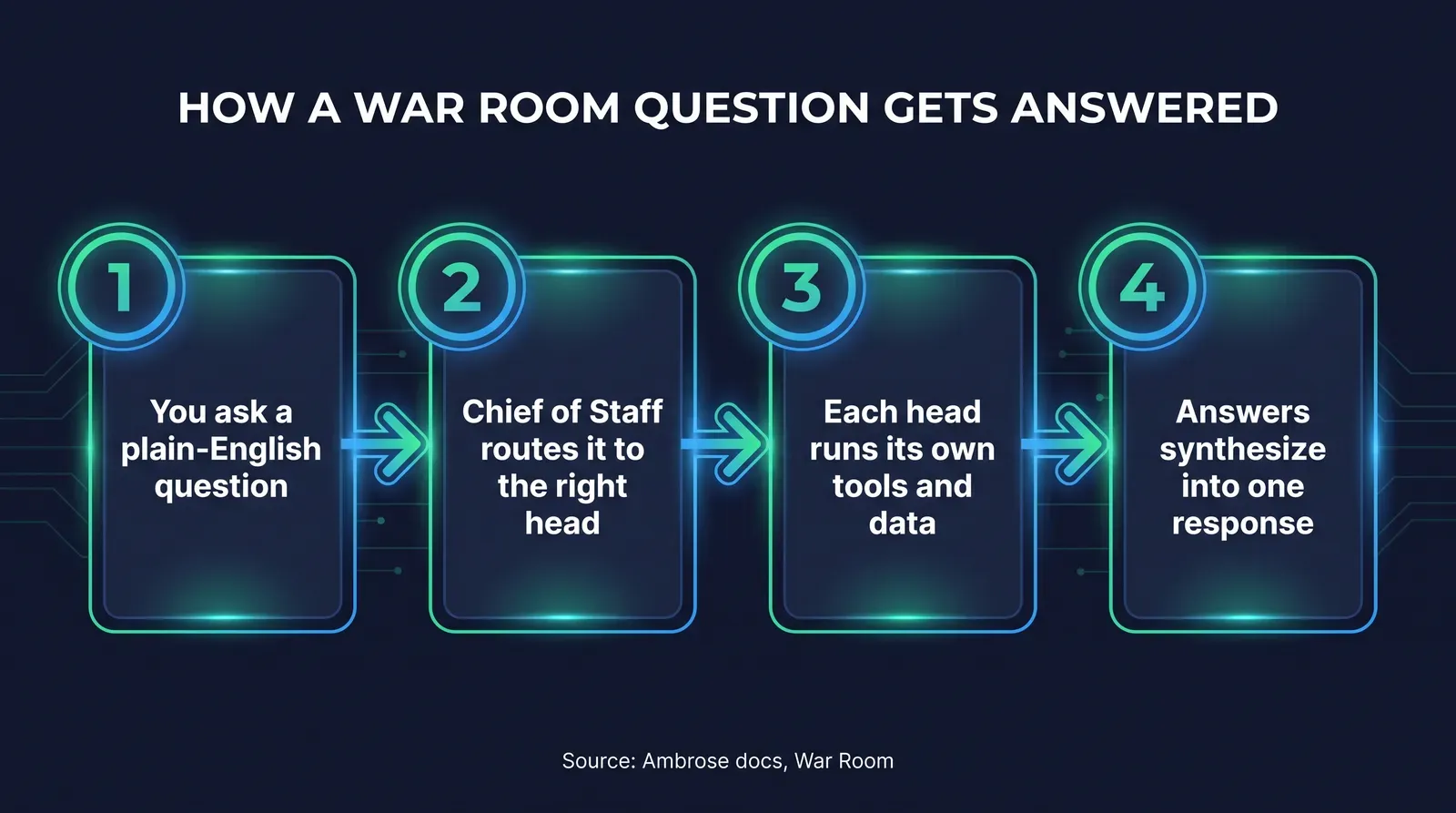
Here’s what that looks like as an actual exchange, not an abstract description. You type: “Should I raise the Meta budget for AEP, and can intake handle the extra volume if it works?” That’s really two questions, a CMO question about whether the spend is earning its keep and a COO question about whether the team can absorb more leads without dropping them, the exact kind of cross-functional question that has no single person to ask at a small agency. In the War Room, Ambrose as Chief of Staff routes the marketing half to the CMO persona, which can pull current cost-per-lead and conversion data from campaign-metrics and GHL, and routes the operations half to the COO persona, which can check current lead response times and open-pipeline volume in GoHighLevel, then synthesizes both into one answer instead of you having to separately think through each half yourself at 9 p.m.
The nine seats aren’t interchangeable, and knowing which one owns which question is most of what makes the routing useful instead of gimmicky. Here’s the roster as Ambrose’s own documentation describes it, mapped to the kind of question a solo agency owner would actually bring to each one:
| Seat | Persona | The question you'd bring to it |
|---|---|---|
| Chief of Staff | Ambrose | Anything, and Ambrose routes it. This is also the one who synthesizes a multi-part answer. |
| CMO | Morgan Chase | Which campaign is actually earning its spend, and what should I cut? |
| CRO | Jordan Knox | Where in the pipeline are leads actually stalling before they close? |
| COO | Alex Rivera | Can intake handle more volume, or does a process break first? |
| CCO (Client Success) | Taylor Brooks | Which clients are at risk of leaving, and why? |
| Compliance | Dr. Elena Reyes | Did this week's outreach actually follow the rule I think it did? |
| Research | Sam Okafor | What changed in a carrier's plan, rate, or policy that affects my book? |
| CFO | Casey Park | Can I actually afford to raise ad spend this month? |
| CTO | Riley Hart | Why did this automation break, and what's the fix? |
| What you get | Manual weekly review (free) | War Room (Ambrose) |
|---|---|---|
| CFO, COO, CMO, Compliance-style input | Yes, if you protect the hour and sit in each seat yourself | Yes, plus CRO, CCO, Research, and CTO personas |
| Reads your actual pipeline and vault data | Only what you manually pull and write down | Yes, directly, per Ambrose's documented examples |
| Available when the question comes up | Only during the protected weekly hour, if it survives | On demand, whenever you have the question |
| Routes a multi-part question to the right specialists automatically | No, you decide which seat to sit in next | Yes, Ambrose as Chief of Staff picks the head(s) and synthesizes one answer |
| Cost | Free, costs one hour a week | One seat included with a Tech Savvy membership; usage billed separately |
The Compliance persona, Dr. Elena Reyes in Ambrose’s documented roster, is worth calling out specifically, because it’s the seat most solo agencies skip entirely under time pressure and the one with the least room for error. Anything a War Room conversation touches involving client identifiers runs through the same PHI Rail used across the rest of Ambrose: for a destination not on the agency’s BAA allowlist, the PHI Gateway aliases identifiers into typed placeholders such as PERSON_xxxx or EMAIL_xxxx using a detection chain of known vault contacts, regex patterns, Presidio NER, and an insurance-specific dictionary, then rehydrates the real values back into the response afterward, logging every scrub event, identifier counts only, never the underlying values (Ambrose docs, PHI Rail architecture). That doesn’t mean every conversation is automatically appropriate for client health detail. It means that when client data does flow through, the identifiers are handled the same documented way everywhere else in the platform, not left to whatever a given conversation happens to include.
Name the mechanism, not just "AI helps you run the business"
What's actually doing the work is specific and documented: nine separate persona sessions, each with its own tool access, routed by a Chief of Staff persona, reading real GoHighLevel and vault data, with PHI aliased before it reaches a non-BAA model. That's a different claim than "AI gives you business advice," and it's the one worth holding Ambrose, or any tool claiming to do this, to.
What if you already have one or two employees?
The 9 p.m. problem doesn’t disappear once an agency hires its first CSR or a part-time producer. It just changes shape. Vertafore’s own data shows the preparedness gap is worst at six or fewer staff, not just at true solo shops, which matches what a small team actually looks like in practice: one or two more people to help with volume, still nobody dedicated to finance, marketing strategy, or compliance as their actual job (Vertafore, 2026 Insurance Agency Trends Outlook). The owner is still the one making the CFO and CMO calls; they’ve just got one more person’s workload to factor into the COO question of whether intake can handle more volume.
A small team changes how the War Room gets used more than whether it’s useful. With staff in the building, the CCO persona’s question, which clients are at risk of leaving, becomes something a team member can act on the same day instead of sitting in the owner’s queue. The COO persona’s read on where intake is bottlenecking can point at a specific process a specific employee owns, not just “things are slow.” The Research persona’s job, catching a carrier plan or rate change that affects the book, matters just as much with three people as with one, because nobody on a three-person team has research as their actual job either. The roster doesn’t change size with the team. What changes is how many of its answers turn into someone else’s task instead of one more thing for the owner to do personally.
What never belongs in a War Room conversation without a second thought
An AI executive team, Ambrose’s or anyone else’s, is still a tool giving you input, not a licensed professional taking on liability for the decision. Two things follow from that, and neither is optional. First: a War Room CFO persona reading your numbers back to you is not a substitute for your actual CPA on your actual tax filing, and a Compliance persona flagging a likely issue is not a substitute for your state’s Department of Insurance guidance or your own compliance counsel on a specific question. Treat it as a fast, well-informed second opinion that still needs a human, you, to verify before anything gets acted on.
Second, this is squarely the kind of AI use the NAIC’s Model Bulletin on the Use of Artificial Intelligence Systems by Insurers has in mind. Adopted by the NAIC membership on December 4, 2023, the bulletin calls for insurers, and in practice this expectation flows down to agencies making AI-supported decisions, to maintain a written program for responsible AI use, commensurate with the risk, covering governance and risk management, with documentation regulators can request during an examination (NAIC, Model Bulletin adoption announcement). Practically, for a solo agency, that’s a one-page document: which decisions you’ll let an AI executive team inform (budget questions, operational bottlenecks, compliance reminders) and which ones still require a licensed professional’s sign-off (anything touching tax filings, contracts, or a specific regulatory determination), reviewed by you before anything gets acted on, not auto-executed. If a War Room conversation touches specific Medicare Advantage, Part D, or Medicare Supplement plan marketing, the existing CMS Medicare Communications and Marketing Guidelines and TPMO disclaimer rules apply exactly as they did before any AI tool was involved.
Verify before you act
Any AI output, from the War Room or any other tool, can contain errors. Read the answer, check it against a number you can independently confirm, and make the actual decision yourself. Results may vary, and nothing in this article is insurance, legal, tax, or compliance advice.
What you get by joining
One Ambrose seat, War Room included, comes with a Tech Savvy Insurance membership: $97 a month, billed monthly, cancel anytime, founding rate locked in while the membership stays active. Ambrose usage runs through its own credit ledger with spend caps, so the cost of actually using it stays visible instead of showing up as a surprise. Alongside the seat: weekly Zoom calls with open Q&A and build-with-you sessions, more than 30 hours of recorded training, Meta Ads and marketing training built specifically for this industry, pre-built AI templates and bot deployments, and a free annual in-person member workshop. It’s also an explicit no-recruiting zone, which matters more than it sounds like it should: you can ask a real question about your agency’s actual numbers without someone sliding into your DMs about a downline an hour later, which isn’t true of most agent Facebook groups.
Close
Everything above, the weekly review structure, the four seats, the specific questions to ask in each one, works whether you ever join anything or not. Build it this week if you want to see exactly what a real executive review is supposed to surface before you hand any part of it to a platform. If you’d rather have that same review running on your actual GoHighLevel and vault data, on demand instead of once a week, with a Compliance persona and eight others in the room, that’s what Ambrose’s War Room already does, and one seat comes with a Tech Savvy membership: https://techsavvyinsurance.com/. See also our breakdown of what Ambrose actually automates and our guide to getting your AI assistant out of one browser tab.
Before you act on any of this
Tech Savvy Insurance is a training and software community, not an insurance company, agency, or law firm, and does not provide insurance, legal, tax, or compliance advice. You are responsible for your own licensure and for complying with HIPAA, the NAIC's AI Model Bulletin as adopted in your state, CMS marketing and TPMO rules where applicable, and your carriers' own vendor and data-handling requirements. AI-generated outputs, including from any tool described in this article, may contain errors: always verify before acting on them. Results may vary.
Frequently asked questions
Sources
- Vertafore — 2026 Insurance Agency Trends Outlook — vertafore.com
- Agent for the Future (Liberty Mutual & Safeco) — 2025 Independent Agents at Work Study — agentforthefuture.com
- Pilot — How Much Does a Fractional CFO Cost? Monthly Pricing Guide (Aug. 18, 2025) — pilot.com
- NAIC — NAIC Members Approve Model Bulletin on Use of AI by Insurers — content.naic.org
- Ambrose docs — War Room — app.hiambrose.com
- Ambrose docs — Spokes — app.hiambrose.com
- Ambrose docs — Architecture — app.hiambrose.com
- Ambrose docs — PHI Rail architecture — app.hiambrose.com
- Ambrose docs — What is Ambrose — app.hiambrose.com
Ready to put this into practice?
Join a private community of Health & Life insurance professionals using AI, Meta Ads, and automation to grow — without draining their bank account.
Join Tech Savvy — $97/month